20 High-Income Skills That Can Help You Earn More Without Working More Hours
20 High-Income Skills That Can Help You Earn More Without Working More Hours
Working longer is not the only way to increase income. Another path is to make each hour of your work more valuable. High-income skills can help employees qualify for better-paying roles, freelancers charge more for specialized services and business owners solve higher-value problems. However, no skill automatically produces a high income. Demand, experience, proof, location, industry and execution still matter.
What Are High-Income Skills?
High-income skills are abilities that can potentially command stronger compensation because they help employers or customers create revenue, save money, reduce risk, improve efficiency or solve difficult problems.
Examples include software development, sales, cybersecurity, data analysis, AI implementation, SEO, financial analysis, project management and specialized consulting.
The phrase does not mean everyone who learns one of these skills will earn a specific salary or freelance rate.
Instead of asking only, “Which skill pays the most?” ask, “Which valuable problem can I learn to solve well enough that employers or clients will pay more for the result?”
Table of Contents
What Makes a Skill a High-Income Skill?
A skill does not become valuable simply because it appears on a popular online list.
Its economic value comes from the problem it solves and how difficult it is to replace the person who can solve that problem well.
Five Factors That Can Increase Skill Value
| Factor | Why It Matters |
|---|---|
| Business Impact | Skills connected to revenue, cost savings, efficiency or risk reduction can create substantial economic value. |
| Scarcity | Skills that are difficult to learn or combine may face less qualified competition. |
| Demand | A strong skill has limited earning potential if few employers or customers need it. |
| Proof | Experience, projects, results, portfolios and qualifications can increase trust. |
| Leverage | Some skills can affect large systems, teams, audiences or business results. |
High Income Is Not Guaranteed
Two people can learn the same skill and earn very different amounts.
One may work in a high-paying industry, while another works in a lower-paying market. One may have years of evidence and strong negotiation skills, while the other is still a beginner.
Therefore, treat high-income skills as opportunities to increase earning capacity rather than guaranteed salaries.

How High-Income Skills Can Help You Earn More Without Working More Hours
Income growth does not always require increasing working hours.
Another strategy is increasing the economic value of the hours you already work.
Example: Hourly Value
| Scenario | Hours | Illustrative Rate | Illustrative Income |
|---|---|---|---|
| General Work | 40 | $20/hour | $800 |
| Specialized Work | 40 | $35/hour | $1,400 |
| Highly Specialized Work | 40 | $50/hour | $2,000 |
These figures are illustrations rather than expected market rates. The principle is simply that higher economic value per hour can increase income without increasing time.
If your available hours are limited, increasing value per hour can be more sustainable than endlessly extending your working day.
Four Ways Skills Create Leverage
| Leverage | Example |
|---|---|
| Technology | Software can automate work across thousands of transactions. |
| Revenue | Sales skills can directly influence business income. |
| Decision-Making | Data analysis can improve expensive business decisions. |
| Systems | Project management can coordinate the work of entire teams. |
Skills 1–7: Technical and Digital High-Income Skills
1 Software Development
Software developers build applications, websites, systems and tools that businesses and consumers use.
Its earning potential can be strong because software can affect large numbers of customers or automate expensive manual work.
How to Build It
Start with programming fundamentals, then build real projects that demonstrate your ability to solve problems rather than merely completing tutorials.
2 Cybersecurity
Cybersecurity professionals help organizations reduce digital threats, protect systems and respond to security incidents.
The skill can carry high economic value because security failures can create significant operational, financial and reputational damage.
Best For
People who enjoy technical problem-solving, systems, investigation and continuous learning.
3 Data Analysis
Data analysts turn raw information into useful insights for decision-making.
Useful tools may include spreadsheets, SQL, visualization software and statistical methods.
4 Data Engineering
Data engineers build systems that collect, transform and organize large amounts of information.
This skill can become particularly valuable inside organizations that depend heavily on reliable analytics and automated data pipelines.
5 AI Implementation and Automation
Businesses increasingly need people who can integrate AI tools into useful workflows rather than simply generate generic content.
Examples include process automation, internal knowledge systems, customer-support workflows and structured data operations.
Important Distinction
Knowing how to use an AI chatbot is different from understanding how to redesign a workflow using AI safely and effectively.
6 Cloud Computing
Cloud skills involve deploying, maintaining and scaling systems through modern cloud infrastructure.
Organizations may value cloud specialists because critical applications and data increasingly rely on distributed infrastructure.
7 No-Code and Workflow Automation
Not every useful automation requires traditional programming.
No-code tools can help businesses connect forms, databases, spreadsheets, email systems and other workflows.
The strongest practitioners understand the underlying business process rather than merely knowing how to connect software tools.

Skills 8–13: Revenue and Business High-Income Skills
8 Sales
Sales is one of the clearest examples of a skill connected directly to business revenue.
Strong sales professionals understand customer needs, communicate value, handle objections and guide genuine prospects toward appropriate decisions.
Avoid confusing professional selling with manipulation or pressure.
9 Copywriting
Copywriters create persuasive written communication for advertisements, landing pages, emails, websites and sales materials.
The skill becomes more valuable when the writer understands customer psychology, positioning, research and measurable business outcomes.
10 Search Engine Optimization
SEO helps websites become easier for search engines and users to understand and discover.
Valuable SEO work can include technical analysis, keyword research, content strategy, internal linking and site architecture.
No ethical SEO professional should guarantee a specific Google ranking.
11 Performance Marketing
Performance marketers manage advertising campaigns focused on measurable business outcomes such as leads, sales or customer acquisition.
The skill requires understanding targeting, creative testing, conversion tracking, economics and attribution.
12 Conversion Rate Optimization
Conversion-rate optimization focuses on improving how effectively websites and funnels turn visitors into leads or customers.
This can involve customer research, testing, analytics, UX improvements and better messaging.
13 Business Development
Business development involves identifying partnerships, markets, customers and strategic growth opportunities.
The skill can combine research, sales, negotiation, relationship building and strategy.
Skills 14–20: Professional and Strategic High-Income Skills
14 Financial Analysis
Financial analysts evaluate financial information, forecasts, budgets, investments or business performance.
The ability to interpret financial information can become highly valuable because major decisions frequently depend on accurate analysis.
15 Project Management
Project managers coordinate people, deadlines, budgets, risks and resources to deliver defined outcomes.
The value comes from helping organizations execute complex work more reliably.
16 Product Management
Product managers help decide what products or features should be built and why.
The role can combine customer research, business strategy, technology and coordination across multiple teams.
17 Negotiation
Negotiation can improve salaries, contracts, freelance rates, purchasing terms and business agreements.
Unlike many skills, negotiation can amplify the financial value of abilities you already possess.
18 Professional Communication
Clear written and verbal communication can increase the value of almost every technical or commercial skill.
Professionals who explain complex ideas clearly may gain greater responsibility, stronger client relationships and more leadership opportunities.
19 Leadership and People Management
Leadership becomes valuable when one person's decisions improve the performance of an entire team.
Good management requires planning, communication, accountability, conflict resolution and judgment—not simply holding a management title.
20 Specialized Consulting
Consultants use deep expertise to help organizations solve difficult or expensive problems.
Consulting can command strong rates when expertise is genuinely specialized and supported by credible evidence.
However, high consulting rates are not a shortcut around building real experience.

Compare the 20 High-Income Skills
| Skill | Learning Difficulty | Main Value Created | Remote Potential | Freelance Potential |
|---|---|---|---|---|
| Software Development | High | Build technology | High | High |
| Cybersecurity | High | Reduce digital risk | High | Medium–High |
| Data Analysis | Medium–High | Improve decisions | High | High |
| Data Engineering | High | Build data systems | High | Medium |
| AI Implementation | Medium–High | Improve workflows | High | High |
| Cloud Computing | High | Support infrastructure | High | Medium |
| No-Code Automation | Medium | Save time | High | High |
| Sales | Medium | Create revenue | High | Medium–High |
| Copywriting | Medium | Improve marketing | High | High |
| SEO | Medium–High | Increase visibility | High | High |
| Performance Marketing | Medium–High | Acquire customers | High | High |
| Conversion Optimization | Medium–High | Improve conversion | High | High |
| Business Development | Medium–High | Create growth opportunities | Medium–High | Medium |
| Financial Analysis | High | Improve financial decisions | Medium–High | Medium |
| Project Management | Medium–High | Improve execution | High | Medium |
| Product Management | High | Guide product decisions | High | Low |
| Negotiation | Medium | Improve financial terms | Universal | High |
| Communication | Medium | Improve clarity and influence | Universal | High |
| Leadership | High | Improve team performance | Medium | Low |
| Consulting | High | Solve specialized problems | High | High |
“High-income” does not mean “easy to learn” or “guaranteed to pay highly.” Several of these skills require years of development before they support advanced compensation.
Skill Stacking: Why Two Skills Can Be More Valuable Than One
One of the most powerful ways to increase earning potential is to combine complementary skills.
The combination can become more valuable because fewer people possess both abilities at a strong level.
MoneyOnliners Original High-Income Skill Reality Filter
MoneyOnliners Earning-Power Formula
The MoneyOnliners High-Income Skill Reality Filter, Earning-Power Formula, Skill Opportunity Score and Skill Stack Framework are original educational frameworks designed to help readers compare skills based on demand, economic value, proof, leverage and portability instead of relying on salary hype.
MoneyOnliners High-Income Skill Opportunity Score
Score each factor from zero to two.
| Factor | 0 Points | 1 Point | 2 Points |
|---|---|---|---|
| Market Demand | Weak | Moderate | Strong |
| Business Value | Low | Moderate | High |
| Skill Scarcity | Common | Moderate | Scarce |
| Portfolio Potential | Hard to prove | Some proof possible | Easy to demonstrate |
| Career Portability | Limited | Moderate | Strong |
| Freelance Potential | Limited | Possible | Strong |
| Personal Fit | Poor | Manageable | Strong |
0–5 Points
Investigate carefully before committing substantial learning time.
6–10 Points
The skill may be worthwhile, but some limitations deserve attention.
11–14 Points
The skill may offer a strong fit if your local or target market genuinely demands it.
This score is an educational comparison framework. It cannot predict future salaries, freelance rates or employment outcomes.
How to Choose the Right High-Income Skill
Step 1: Start With the Market
Look for real jobs, freelance projects and business problems rather than beginning with influencer lists.
Step 2: Look at Your Existing Strengths
Someone with strong analytical ability may enjoy data analysis. A persuasive communicator may develop faster in sales.
Step 3: Estimate Learning Time
Some skills can reach a useful beginner level within months. Others may require years of structured development.
Step 4: Evaluate the Cost
Consider courses, software, certifications and equipment before committing.
Step 5: Build Proof Early
Projects can reveal whether you genuinely enjoy the work and help demonstrate ability.
Step 6: Enter the Market Before You Feel Perfect
Once you have enough competence to perform responsibly, begin applying for suitable roles or projects.
Step 7: Combine Skills Strategically
Adding communication, sales, data or business knowledge to a technical skill may increase your usefulness substantially.
A 12-Month High-Income Skill Roadmap
Months 1–3: Foundation
- Choose one primary skill.
- Study market demand.
- Learn core concepts.
- Practice several times each week.
- Avoid buying multiple expensive courses.
- Complete small exercises.
- Identify the types of jobs or clients that use the skill.
Months 4–6: Build Proof
- Create two to four serious projects.
- Document what problem each project solves.
- Improve your portfolio.
- Seek feedback from knowledgeable people.
- Identify your strongest sub-skill.
- Study real job descriptions.
- Close obvious skill gaps.
Months 7–9: Enter the Market
- Apply for relevant roles.
- Offer suitable freelance services where appropriate.
- Practice interviews.
- Improve your professional profile.
- Learn basic negotiation.
- Record market feedback.
- Continue improving weak areas.
Months 10–12: Increase Value
- Develop a complementary second skill.
- Specialize around higher-value problems.
- Improve your evidence of results.
- Seek larger responsibilities.
- Review compensation against market opportunities.
- Improve negotiation skills.
- Create a plan for the next 12 months.
10 High-Income Skill Mistakes to Avoid
1. Choosing a Skill Only Because Someone Claims It Pays Well
High compensation in one market does not guarantee strong opportunities in another.
2. Learning Without Building Projects
Watching tutorials can create familiarity without creating real competence.
3. Learning Too Many Skills at Once
Constant switching can prevent you from becoming useful enough in any one area.
4. Ignoring Communication
Technical ability becomes less valuable if you cannot explain your work clearly.
5. Ignoring Sales and Negotiation
Strong skills do not always sell themselves.
6. Collecting Certificates Without Building Ability
Credentials can help in some industries, but they should support genuine competence.
7. Expecting a High Salary Immediately
Beginners normally need evidence, experience and market feedback before reaching advanced compensation.
8. Ignoring Industry Knowledge
The same technical skill can become more useful when combined with deep understanding of a specific industry.
9. Relying Completely on AI
AI can improve productivity, but professionals remain responsible for quality, accuracy and judgment.
10. Working More Instead of Increasing Value
Additional hours can increase income temporarily, but long-term earning growth often requires stronger skills and leverage.
Why High-Income Skills Matter
1. First, high-income skills can increase the economic value of your working time.
2. Stronger skills may help employees qualify for better-paying roles.
3. Meanwhile, freelancers may become able to solve higher-value client problems.
4. Business owners can also use valuable skills to improve efficiency and growth.
5. Therefore, skill development can support income growth without simply extending working hours.
6. Valuable skills can also improve career mobility.
7. A portable skill may create opportunities across multiple industries.
8. Some skills can support both employment and freelance work.
9. That flexibility may reduce dependence on one income pathway.
10. However, learning a skill does not automatically create demand.
11. Market research remains important.
12. Likewise, proof of ability often matters more than simply claiming expertise.
13. Projects and real work can strengthen credibility.
14. Negotiation can further increase the value captured from your skills.
15. Communication can make specialized knowledge easier for others to understand and trust.
16. Skill stacking can create additional scarcity.
17. For example, technical expertise combined with business knowledge can be especially useful.
18. Over time, stronger skills can create more career choices.
19. Those choices can improve financial resilience and long-term income potential.
20. Ultimately, developing high-income skills matters because increasing the value of your work can be a more sustainable path to higher income than simply adding more hours to every week.
Incoming Link Opportunities
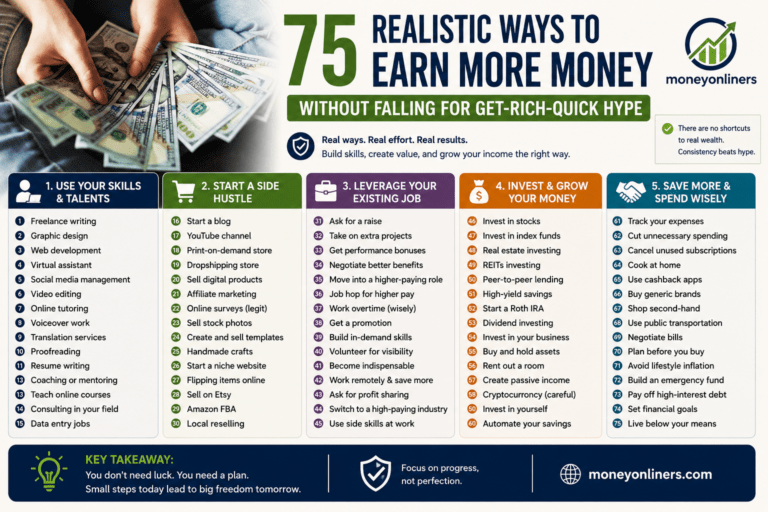
75 Realistic Ways to Earn More Money Without Falling for Get-Rich-Quick Hype
https://moneyonliners.com/ways-to-earn-more-money/
30 Ways to Make Money Online for Beginners With Little or No Experience
https://moneyonliners.com/ways-to-make-money-online-for-beginners/
How to Make an Extra $1,000 a Month: 20 Realistic Income Ideas
https://moneyonliners.com/make-an-extra-1000-a-month/
50 Ways to Make Money From Home Without Starting a Full-Time Business
https://moneyonliners.com/ways-to-make-money-from-home/
High-Priority Incoming Links
Earn More Money: Practical Ways to Increase Your Income
https://moneyonliners.com/earn-more-money/
Grow Your Income
https://moneyonliners.com/grow-your-income/
Jobs & Careers
https://moneyonliners.com/jobs/
Freelancing
https://moneyonliners.com/freelancing/
Topic Cluster Incoming Links
Remote Work
https://moneyonliners.com/remote-work/
AI Income
https://moneyonliners.com/ai-income/
Side Hustles
https://moneyonliners.com/side-hustles/
Recommended External Resources
U.S. Bureau of Labor Statistics — Occupational Outlook Handbook
Occupational Outlook Handbook — U.S. Bureau of Labor Statistics
Useful for researching occupations, typical educational requirements, job duties and broader employment outlook information.
O*NET OnLine
Provides detailed information about job skills, abilities, knowledge and occupational requirements.
CareerOneStop
Provides career exploration, training and job-search resources.
Federal Trade Commission — Job Scams
Job Scams — Federal Trade Commission
Useful when evaluating training programs, recruiters or employment offers connected to career opportunities.
U.S. Small Business Administration
Business Guide — U.S. Small Business Administration
Useful for readers who later convert specialized skills into freelance or business services.
Salary levels, freelance rates, employment opportunities and skill demand vary by occupation, experience, employer, industry, country and location. This guide provides educational information rather than a promise that learning any particular skill will produce a specific income.
Frequently Asked Questions
What is a high-income skill?
A high-income skill is an ability that can potentially command stronger compensation because it solves valuable problems.
That value may come from increasing revenue.
It may also come from reducing costs, improving efficiency or reducing risk.
However, the term does not imply guaranteed income.
Market demand and proof of competence still matter.
What high-income skill is easiest to learn?
There is no universally easiest skill.
A strong writer may find copywriting more accessible than software development.
Someone comfortable with numbers may prefer data analysis.
Meanwhile, a persuasive communicator may progress faster in sales.
Choose based on aptitude and market demand rather than simplicity alone.
What high-income skills can I learn without a degree?
Some employers and clients emphasize skills and evidence more than formal degrees.
Examples may include sales, copywriting, SEO, certain forms of digital marketing and no-code automation.
Software development can also be learned outside traditional university programs.
However, some employers still prefer or require degrees.
Always check the requirements of the specific career path.
How long does it take to learn a high-income skill?
The timeline varies considerably.
A beginner may learn basic foundations within several months.
Professional competence usually takes longer.
Advanced expertise may require years of practice.
Avoid programs promising mastery in unrealistic periods.
Which high-income skills are good for remote work?
Software development, data analysis, copywriting and SEO can often be performed remotely.
Digital marketing may also provide remote opportunities.
Consulting and project management can sometimes be remote.
However, employer policies differ.
Remote availability should be verified for individual roles.
Which high-income skills are good for freelancing?
Copywriting, SEO, design, software development and marketing can all support freelance services.
Data analysis and automation may also create freelance opportunities.
Specialized consulting can eventually command strong rates.
However, freelancing requires customer acquisition in addition to technical skill.
A valuable skill alone does not automatically create clients.
Is sales a high-income skill?
Sales can have strong earning potential because it connects directly to business revenue.
Some roles use commissions or performance-based compensation.
However, compensation structures vary widely.
Professional selling also requires customer understanding and communication.
High-pressure manipulation should not be confused with strong sales ability.
Is coding still a valuable skill?
Software development remains useful because organizations continue to rely on software systems.
However, tools and workflows continue changing.
Developers increasingly need problem-solving ability rather than memorizing syntax alone.
AI tools may improve productivity.
Human judgment and system understanding remain important.
Is AI a high-income skill?
AI can become valuable when combined with real business or technical knowledge.
Simply knowing how to use an AI chatbot is usually not enough.
Greater value may come from integrating AI into workflows.
Quality control and data handling matter.
Strong practitioners combine AI knowledge with another useful domain.
Is SEO a high-income skill?
SEO can be valuable because organic search can influence traffic and customer acquisition.
However, the field requires ongoing learning.
Technical SEO, content strategy and analytics can all be important.
Search results are not fully under an SEO professional's control.
Therefore, guaranteed rankings should be treated cautiously.
Can I learn two high-income skills at once?
You can, although beginners may progress faster by choosing one primary skill first.
After building basic competence, a complementary skill can create additional value.
For example, data analysis pairs well with communication.
SEO pairs naturally with writing.
Skill stacking works best when the abilities reinforce one another.
What is skill stacking?
Skill stacking means combining multiple useful abilities.
The goal is not necessarily becoming world-class at each one.
Instead, the combination can make you unusually useful.
For example, technical knowledge plus sales can support specialized business-development roles.
The strongest combinations usually solve a clearer business problem.
Can high-income skills help me earn more without overtime?
Potentially, yes.
If stronger skills help you qualify for a higher-paying role, your income may increase without increasing weekly hours.
Freelancers may also improve rates as their value rises.
However, learning the skill itself requires time.
There is no guarantee that compensation will increase immediately.
Should I learn a skill or start a side hustle?
The two strategies can work together.
A side hustle based on a weak skill may remain low paying.
Building a stronger skill first can improve future side-hustle economics.
Alternatively, a small side project can help you practice the skill.
Choose according to your current income needs and long-term goals.
Do certificates make a skill high income?
Not automatically.
Certifications can help demonstrate knowledge in some industries.
However, employers and customers also care about competence.
Projects and practical experience can strengthen credibility.
Research whether the specific certificate has genuine market recognition before paying for it.
What is the best high-income skill to learn first?
The best choice depends on your strengths and target market.
Start by researching real jobs and customer needs.
Identify skills that appear repeatedly.
Then choose one that fits your aptitude and available learning time.
Market demand plus personal fit is usually more useful than choosing from a generic ranking.
Research Methodology
Skill Selection
MoneyOnliners selected skills that can potentially create meaningful economic value through revenue generation, cost reduction, efficiency, decision-making, risk reduction or organizational leverage.
Income Claims
No fixed salary or freelance-rate claims are assigned to individual skills because compensation varies substantially by occupation, employer, experience, location and market conditions.
High-Income Definition
The phrase “high-income skill” is used as an educational description of skills with potentially strong earning leverage rather than a guarantee that every practitioner earns a high income.
Comparative Framework
The guide compares skills using factors including demand, economic value, scarcity, evidence, portability and freelance potential.
Original MoneyOnliners Analysis
The High-Income Skill Reality Filter, Earning-Power Formula, Skill Opportunity Score and Skill Stack Framework are original MoneyOnliners educational frameworks.
First-Hand Evidence Standard
MoneyOnliners only presents personal salary increases, freelance rates, client payments, promotion outcomes or professional results when genuine first-hand evidence exists and can be represented accurately.
Accordingly, this guide does not claim that MoneyOnliners or its founder personally earns a high income from all 20 skills.
Limitations
Skill demand changes over time. Technology, automation, industry conditions, economic cycles and local labor markets can all influence compensation and opportunity.
Readers should therefore research current job openings and market conditions before making major education or career investments.
Google Search Console Checklist
- Confirm final URL: /high-income-skills/
- Confirm canonical matches the published URL.
- Confirm the page is indexable.
- Confirm the URL appears in the XML sitemap.
- Use high-income skills naturally in the introduction, headings, FAQ and conclusion.
- Use related phrase: high-paying skills.
- Use related phrase: skills that can increase your income.
- Use related phrase: best skills to learn to earn more money.
- Use related phrase: valuable career skills.
- Use related phrase: skills that pay well.
- Add an internal link from Grow Your Income.
- Add an internal link from Earn More Money.
- Add an internal link from Jobs & Careers.
- Add an internal link from Freelancing.
- Add an internal link from AI Income.
- Add links from the beginner online-income article.
- Add links from relevant Career Academy lessons.
- Add links from Digital Skills Academy.
- Check all 20 numbered skills on mobile.
- Compress article images before upload.
- Use unique descriptive image alt text.
- Verify all external career-resource links.
- Check every internal MoneyOnliners link before publishing.
- Inspect the published URL in Google Search Console.
- Request indexing after publication if appropriate.
- Monitor “high-income skills.”
- Monitor “high-paying skills.”
- Monitor “best skills to learn to earn more money.”
- Monitor “skills that increase income.”
Conclusion: Increase the Value of Your Hours, Not Just the Number of Hours
There are only so many hours in a week.
That is why long-term income growth cannot depend entirely on working longer.
Choose a Valuable Problem
Strong earning potential usually begins with problems employers and customers care enough about to pay to solve.
Build Real Competence
Courses can help you learn, but projects and actual work help transform knowledge into ability.
Build Proof
A portfolio, documented projects, qualifications or professional results can make your skills easier for others to trust.
Add Complementary Skills
Communication, sales, negotiation and business knowledge can increase the economic value of technical expertise.
Then Capture More of the Value
Better jobs, stronger negotiation, higher-value freelance work and greater responsibility can turn stronger skills into higher earning potential.
HIGHER INCOME CAN ALSO = MORE VALUE PER HOUR
You do not need to learn all 20 skills.
One valuable primary skill combined with one or two complementary abilities can create a much stronger professional position than constantly chasing whatever skill is currently trending online.