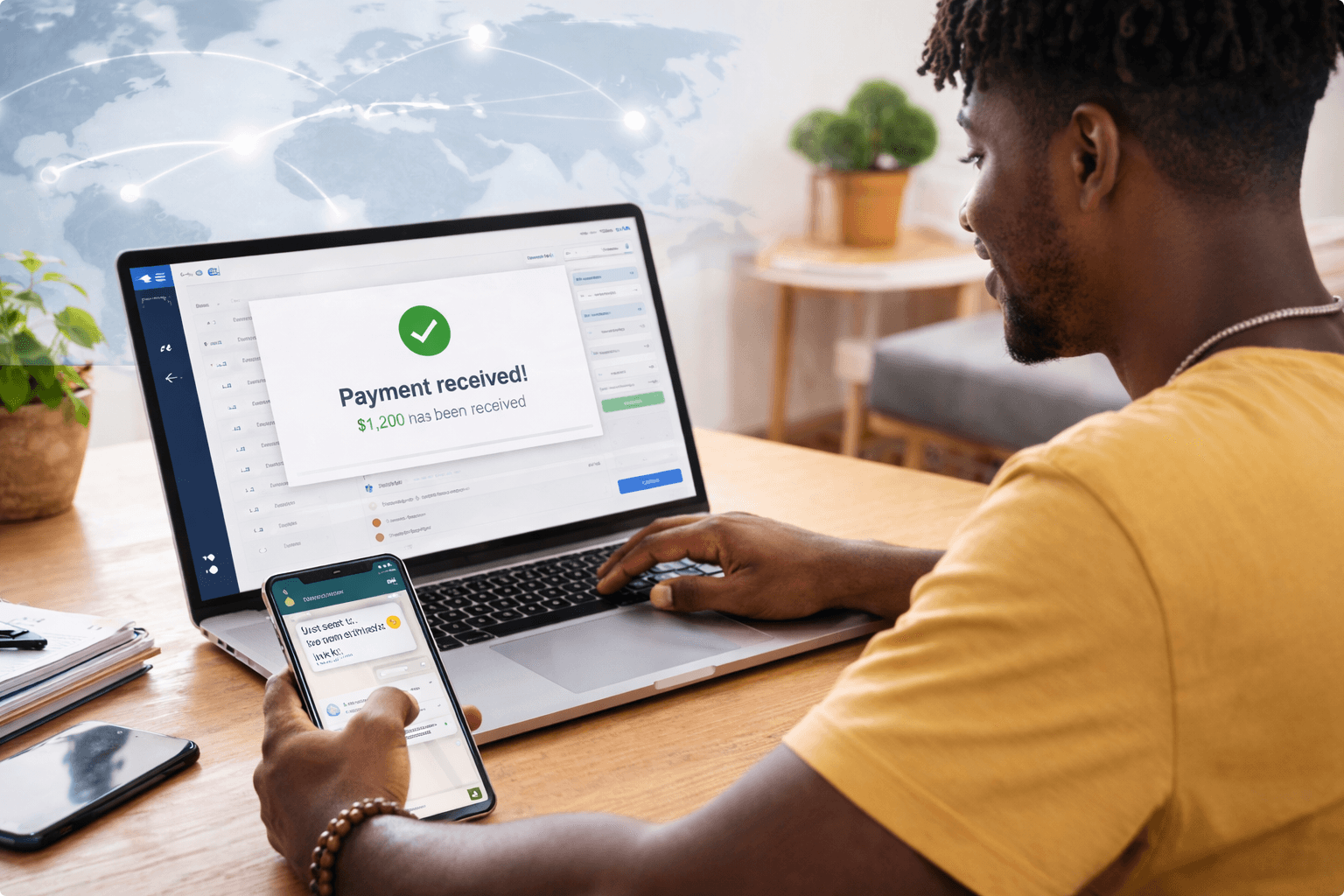
Best Online Payment Methods (Global Guide 2026)
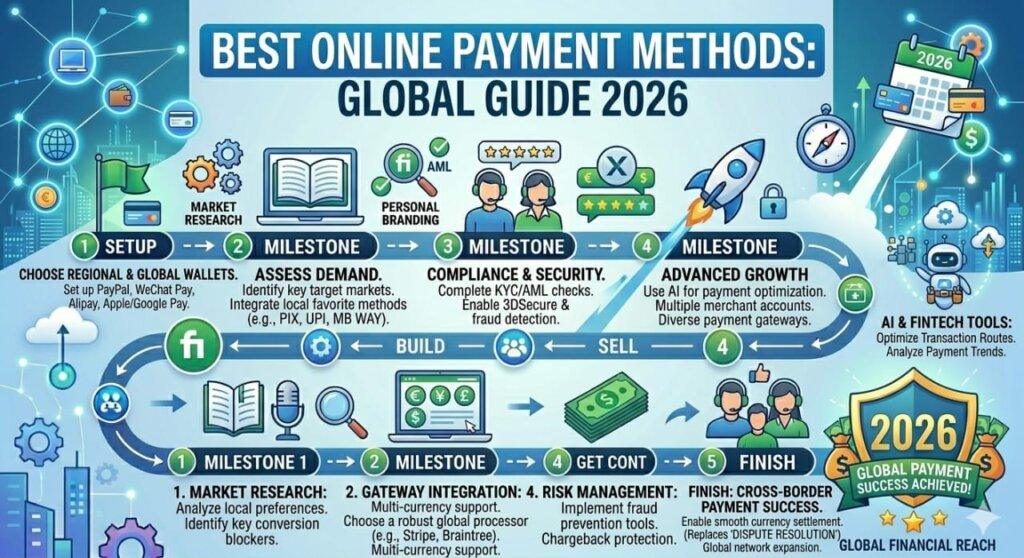
Introducation:
Choosing the right online payment methods is essential for anyone earning money online. In this guide, we’ll explore the best online payment methods for freelancers and online businesses in 2026.
Whether you work with global clients or earn online, the right payment platforms can help. PayPal, Payoneer, and Wise let you get paid fast and safely.

Getting paid online as a freelancer in 2026 is easier than ever.
But choosing the right payment method worldwide can affect how much money you keep.
Many freelancers lose 20–50% of earnings due to hidden fees, exchange rates, and slow transfers if they choose the wrong platform.
PayPal vs Payoneer in 2026: The Hidden payment methods Freelancers Don’t See

In 2026, freelancers worldwide move billions of dollars through digital wallets. Platforms like PayPal and Payoneer are household names—but many freelancers only notice the upfront fees, not the true cost.
As global freelancing grows, understanding hidden platform charges is critical to protecting your profit.
This article explains what it costs to get paid through PayPal and Payoneer in 2026.It also covers fees many freelancers miss until their earnings shrink.
2. 📊 How Freelancers Get Paid Worldwide
Freelancers typically get paid through:
- Direct bank transfers
- Payment platforms (PayPal, Payoneer, Wise, Skrill)
- Invoicing tools
- Marketplace payouts (Upwork, Fiverr)
Among these, PayPal and Payoneer are the most widely used worldwide—but:
- 👉 Both include hidden charges that reduce your take-home pay.
- 👉 Many freelancers underestimate 2026 payments by 20–50%.
3. 💳 PayPal in 2026 – Payment Costs Freelancers Often Miss
PayPal remains one of the most recognized global wallets, but its fee structure is layered and easy to underestimate.
📌 3.1 PayPal Transaction Dues
Press enter or click to view image in full size
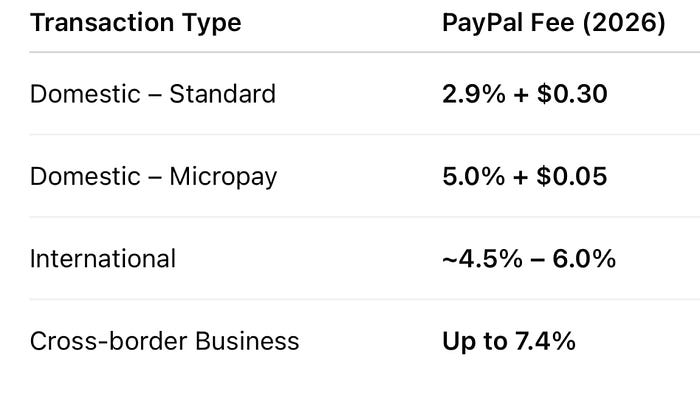
PayPal Transaction payments Table
💡 Key insight: When a client pays from another country, PayPal usually applies the higher international payments tier.
📌 3.2 Currency Conversion payments
PayPal does not use the mid-market exchange rate.
Instead, it typically adds a 3% to 4% markup on top of the market rate—quietly reducing what you receive.
📈 Example:
A client pays €1,000 → PayPal converts it to USD at a rate noticeably worse than the market rate.
📌 3.3 Receiving Payment Traps
Some freelancers assume “Friends & Family” avoids fees.
⚠️ Reality: PayPal may reclassify a payment as a business transaction if it suspects business activity. This can happen up to 180 days later.
📌 3.4 Withdrawal Dues
Press enter or click to view image in full size
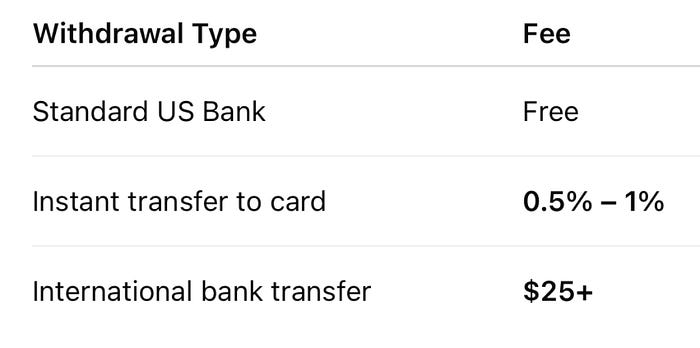
Image: Withdrawal Fees Table
International and cross-border withdrawals can become one of the biggest hidden costs for freelancers working with global clients.
Press enter or click to view image in full size

4. 💸 Payoneer in 2026 — payments You Might Be Missing
Payoneer is built for freelancers and remote workers and often costs less than PayPal—but it isn’t fee-free.
📌 4.1 Payoneer Transaction payments
Press enter or click to view image in full size
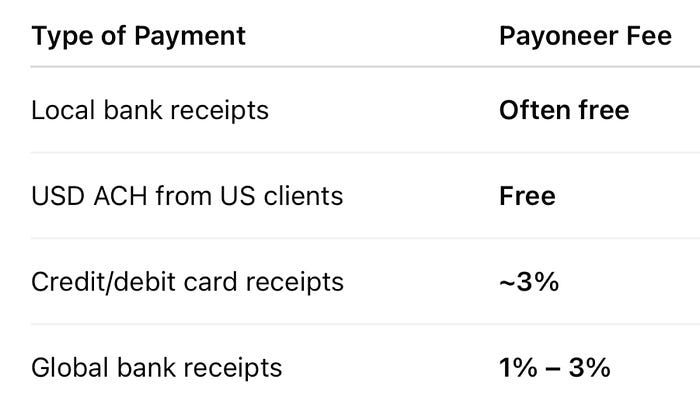
Image: Payoneer Transaction dues
👉 Payoneer is often more cost-effective for recurring business payments.
📌 4.2 Currency Conversion Markups
Payoneer typically adds about 2% above the mid-market exchange rate. That’s lower than PayPal’s 3–4%, but it can still take a noticeable cut from your payout.
📌 4.3 Account & Inactivity Dues
Payoneer may look “no hidden fees” at first—but there’s one many freelancers miss:
⚠ $29.95 annual inactivity fee
📌 4.4 Card & ATM Dues
If you use a Payoneer prepaid card, additional card and ATM fees may apply.
Press enter or click to view image in full size
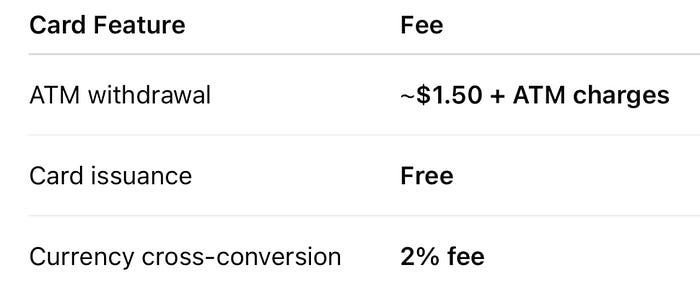
Image: Card & ATM Fees
5. 📈 PayPal vs Payoneer — Side-by-Side payments Comparison (2026)
Press enter or click to view image in full size
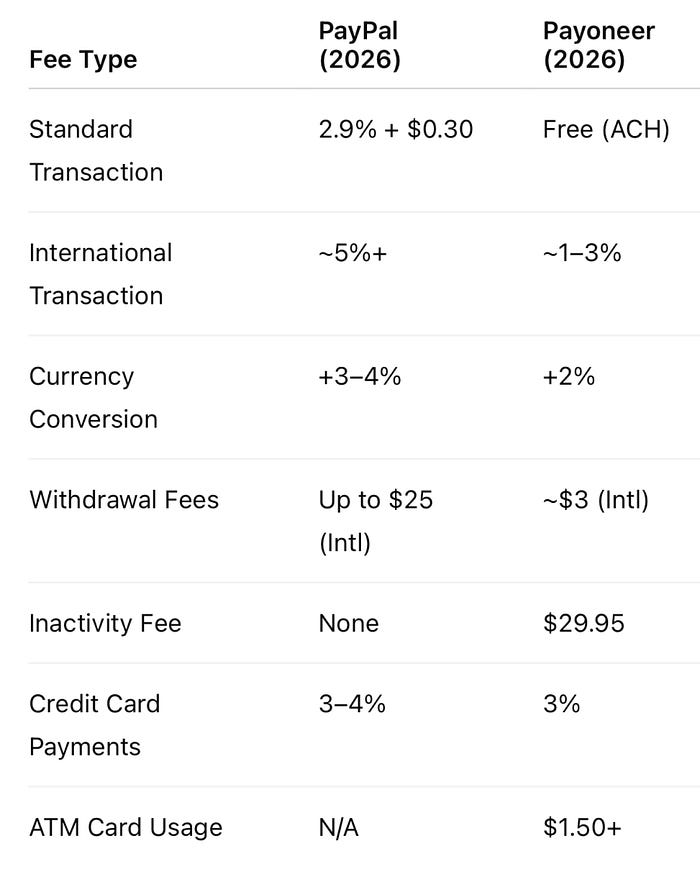
Image: PayPal vs Payoneer — Side-by-Side Fee Comparison (2026)
6. 🔎 Real Freelancer Case Studies
💡 Case Study — European Designer
- Project payment: €2,000
- PayPal fees + conversion: ~$1,850 net
- Payoneer fees + conversion: ~$1,920 net
👉 Payoneer saved about $70 on a single payment.
💡 Case Study — US–Africa Remote Worker
- Client payment: $1,500 (US-based client)
Press enter or click to view image in full size
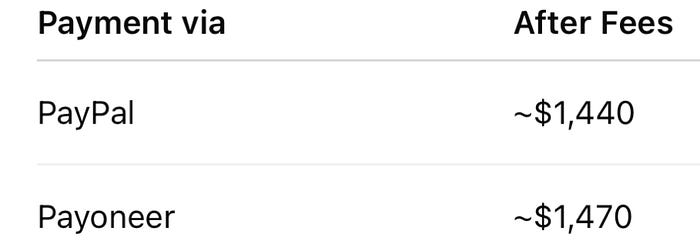
Image: Real Freelancer Case Studies (PayPal vs Payoneer conversion & fees)
👉 Payoneer still wins for cross‑border work
Press enter or click to view image in full size

7. Which Platform Is Best in 2026?
Choose PayPal if:
- Your clients already use PayPal
- You need fast payouts in major markets
- You mostly invoice small domestic payments
Choose Payoneer if:
- You get paid in multiple currencies
- You want lower international fees
- You receive frequent recurring payments
- You want cheaper bank transfers
8. Payment-Saving Tips for Freelancers
- Ask clients to pay via local-currency ACH when available
- Avoid credit card payments when you can
- Use Payoneer for international payments when possible
- Transfer money in larger batches to reduce withdrawal fees
- Avoid PayPal currency conversion fees—convert with Wise if it’s cheaper
Related comparisons you may find useful:
Wise vs Payoneer: Which Is Cheapest for International Clients?
Wise vs PayPal: Hidden Fees Compared (saving on PayPal charges)
Stripe vs PayPal: Complete Fee Breakdown for Freelancers
Best Payment Platforms by Country: Top Choices for Freelancers
References
- PayPal Fee Overview — paypal.com/business/fees
- Payoneer Pricing — payoneer.com/pricing
- Statista Freelance Economy Reports
- Upwork / Fiverr Payout Studies
- Forbes — Hidden International Payment Fees
Whether you work on:
- Upwork
- Fiverr
- With direct clients
- Through your own website
You need a fast, low-fee, widely accepted payment method.
Many freelancers lose money because of:
- High fees
- Poor exchange rates
- Slow withdrawals
Before you choose a payment method, make sure you understand how online income works:
🔗 https://moneyonliners.com/how-online-income-actually-works/
Then follow the full earning system:
🔗 https://moneyonliners.com/how-to-make-money-online-2026/
Why Payment Methods Matter (Global Perspective)
Freelancers often work with clients across:
- The United States
- Europe
- Africa
- Asia
That means you need:
- Multi-currency support
- Fast international transfers
- Low conversion costs
Online payment platforms help you:
- Send and receive payments globally
- Hold and use multiple currencies
- Track transfers securely
How to Pay Freelancers: Payment Methods for Every Type of Project
Not sure how to pay freelancers? Use this list of payment options to compare the benefits and trade-offs, and choose what works best for both domestic and international contractors.

Table of contents
Choosing the right way to send money matters. This is true whether you hire independent contractors for one project or on a recurring basis. Since you have many payment methods, we can help.Options include PayPal, credit or debit cards, direct deposit, crypto, wire transfers, and more.We’ll help you choose the best option for your business.
In this article, we’ll cover popular freelancer payment options. We’ll explain clear payment terms and how to choose the best method. We’ll consider fees, freelancer preferences, and international transfers.
Keep reading for tips on freelancer payments, or skip ahead to learn about the pros and cons of each payment method.
And just to let you know – we’ll use the terms freelancer and independent contractor interchangeably in this article. 
Key takeaways:
- Pick payment methods that match your needs. ACH works well for U.S.-based freelancers. Platforms like Wise or Useme can simplify international payments and often cost less.
- Collect the right tax forms before you pay. Use Form W-9 for U.S. contractors and Form W-8BEN for contractors outside the U.S. This helps you stay compliant with IRS rules.
- Set payment terms upfront. Confirm your rate structure (hourly, project-based, or milestone), your payment window (often 7–14 days), and fees for out-of-scope work to prevent disputes.
- File Form 1099-NEC by January 31 if you pay U.S. contractors more than $600 in a year. Keep payment records for at least four years.
- Use contracts to protect your business. Document scope, deadlines, payment terms, and intellectual property rights. Platforms like Useme can also support this process.
Plan your freelancer payments strategically
There’s no one-size-fits-all solution. The best payment method depends on your business structure, budget, and long-term plans.
Before you start paying freelancers, answer these strategic business questions:
- How many independent contractors do you plan to hire?
- Will you only work with local professionals, or do you want to stay open for international talent?
- Are you hiring freelancers for specific projects, or do you also need to manage full-time employees?
- Will you send recurring payments or one-time payments per project?
- Will multiple clients or departments need to approve or manage payments?
- What’s your total budget, including transaction fees and other costs?
- Are you already using accounting software, a payment platform, or another tool for contractor payments?
Your answers will help you choose a cost-effective option that can scale. They’ll also help you handle international transfers, collect the right tax forms, and keep payments aligned with your existing systems.
Freelancer payment methods – overview
Here are the most common ways to pay freelancers, along with the main pros and cons.
Here’s a quick comparison of typical freelancer payment methods:
| Payment method | Best for | Processing time | Fees | Security level |
|---|---|---|---|---|
| ACH transfers | U.S. freelancers and recurring payments | 1–3 business days (same-day available for higher fees) | $0–$3 per transfer | High (bank-level encryption) |
| Wire transfers | Large, urgent payments | Same day to 2 days | High ($25–$50+) | High / medium-high |
| Useme | Freelancer payments with built-in compliance | 1–2 days | 4.99% of the invoice amount | High (escrow protection) |
| Card payments | Fast one-time payments | Instant | 2.9–3.5% + fees | High |
| Tipalti | Global payouts at scale, compliance | 1–3 days (varies by method) | Varies by method, currency, and location | High (vendor verification) |
| Checks | Traditional processes, limited banking access | 5–10 days | None (domestic) | Low (can be lost or forged) |
| PayPal / Wise | International, mid-value payments | Minutes to 1 day | 0.33–5% | High |
| Cryptocurrency | Tech-savvy freelancers, fast cross-border payments | 10 minutes to a few hours | $0.50–50%+ | Medium (often irreversible) |
| Venmo / Cash App | Small, informal jobs | Instant | 1.75% (instant) / $0 (standard) | Low (limited business protections) |
| Freelancer marketplaces | First-time hires, project-based work | 3–7 days | 5–20% | High |
Electronic funds transfer / bank transfers
Bank transfers send money directly from your account to the freelancer’s. They’re secure, reliable, and commonly used for both domestic and international payments.
ACH direct deposit is mainly used for U.S. payments. Wire transfers can be domestic or international, but they usually cost more and aren’t reversible.
Pros:
- Secure and traceable
- No third-party platform required
- Works well for large or recurring payments
- Domestic transfers can be fast
Cons:
- High fees for international wire transfers
- Slower processing for cross-border payments
- Requires full bank details (IBAN, SWIFT, etc.)
- Less flexible than digital wallets
Best for: U.S. contractors, large payments, or recurring work.
ACH transfers
ACH (Automated Clearing House) transfers are electronic payments between U.S. bank accounts. They’re widely used for payroll, direct deposit, and recurring payments. ACH is a strong option for paying U.S.-based freelancers when you don’t need instant delivery.
Pros:
- Low or no processing fees
- Secure and reliable for domestic payments
- Great for recurring transfers
- No checks or third-party platforms needed
Cons:
- Only available in the U.S.
- Slower than wires (1–3 business days)
- Requires accurate routing and account numbers
- Not ideal for urgent payments
Best for: Paying U.S.-based freelancers by direct deposit, especially for scheduled payments.
Tipalti
Tipalti is an accounts payable automation platform built for companies that need to pay many vendors globally and manage onboarding at scale. It’s especially useful when you pay freelancers across multiple countries on a regular basis.
Tipalti supports multi-currency payments to 200+ countries and offers several payout options, including ACH, wire transfers, PayPal, and local bank transfers.
Pros:
- Speeds up payment processing
- Built-in tax compliance tools
- Strong audit trails and reporting
- Freelancers can choose how they get paid
Cons:
- Fees can add up with many small payments
- Requires setup time and onboarding
- May be too complex if you only pay a few freelancers
Best for: Businesses paying 20+ freelancers regularly, teams with multi-step approvals, or organizations that need detailed compliance reporting.
Useme
Useme is a Europe-based platform built for freelancer payments. It helps you pay securely, manage contracts, and stay compliant—without the usual paperwork. This can be especially helpful when you work with international freelancers.
Useme goes beyond payments. It also acts as a legal intermediary by signing a contract with the freelancer, handling tax documentation, and issuing a clear invoice to your business.
You can also browse vetted freelancers on Useme Jobs and hire through the platform. Many are based in Central and Eastern Europe and offer strong quality at competitive rates.
Useme’s service fee is 4.99% of the invoice amount, with a minimum of $9 and a maximum of $99 per transaction.

Pros:
- You can pay all your freelancers in a few clicks,
- tax-compliant invoice issued directly to your business,
- legally binding contracts created on your behalf,
- fast cross-border transfers – freelancers usually get the money within a day or two,
- no need to collect personal or banking data from freelancers,
- freelancers can pick how they want to receive payments (e.g., they can get paid via PayPal or Payoneer, even if you choose a bank transfer or card payment)
Cons:
- some freelancers may need a brief onboarding,
- Customer Service available in the UTC+2 timezone,
- It’s better if you create an account.
Best for: All types of freelance payments – domestic and international, for one-off jobs, long-term projects, and recurring tasks.
Useme vs Tipalti – which one is for you?
Having two freelancer platforms at hand, let’s compare them. While both platforms simplify gig work payments, they serve different scales and use cases:
| Feature | Useme | Tipalti |
| Best for | Small to medium businesses (1–50 freelancers) | Large enterprises (50+ freelancers, complex workflows) |
| Setup complexity | Low (quick account creation) | Medium (requires IT integration) |
| Payment methods | Bank transfer, card payments | ACH, wire, PayPal, local bank transfer, checks |
| Fees | 4.99% of invoice (min $9, max $99) | Depends on method, currency, and location |
| Freelancer onboarding | Simple (email invite, form completion) | More detailed (tax forms, compliance checks) |
| Mass payouts | Manual (you choose the invoices you want to pay at once) | Automated (batch process hundreds at once) |
| Approval workflows | Basic (you approve, payment processes) | Advanced (multi-level approvals, spending limits) |
| Reporting | Invoice history, payment tracking | Detailed analytics, audit trails, custom reports |
When to choose Useme:
- You’re paying 1-50 freelancers.
- You want a simple, fast setup without IT involvement.
- Your freelancers are primarily in Europe or international (Useme specializes in cross-border payments).
- You value having legally binding contracts created automatically for each project.
- You prefer paying a percentage fee rather flat fee.
When to choose Tipalti: Best online payment methods for freelancers worldwide
- You’re paying 50+ freelancers regularly.
- You need complex approval workflows (e.g., manager approves work, finance approves payment).
- You require detailed compliance reporting for audits.
- You want to batch process hundreds of payments at once.
- You prefer paying flat per-payout fees rather than percentage fees (cost-effective for large payments).
Card payments
Using a credit or debit card to pay freelancers is fast, secure, and widely accepted on most platforms. However, it typically involves processing fees, which freelancers may pass on to you.
Pros:
- fast and secure payments,
- works well for international freelancers,
- allows you to use card rewards or benefits,
- fraud protection from card providers
Cons:
- high transaction fees,
- not ideal for large payments due to added costs,
- not all freelancers accept payments via card,
Best for: quick one-time payments, especially through digital platforms with built-in card processing.
Checks
Though less common today, checks – both paper and electronic – are still used by some businesses to pay independent contractors. This method may suit traditional payroll systems or situations where the freelancer doesn’t have a bank account.
Pros:
- no payment platform needed,
- no fees on domestic transactions,
- tangible paper trail for accounting,
- eChecks are faster than paper ones
Cons:
- slow delivery and clearing times,
- can get lost in the mail,
- risk of bounced checks,
- not suitable for international payments
Best for: Domestic freelancers, businesses with traditional payment systems, or cases without bank access.
Digital payment platforms
Online payment platforms like PayPal, Wise, Stripe, and Payoneer make it easy to send money to independent contractors worldwide. They support multiple currencies and often include tools like invoicing and payment tracking.
Pros:
- fast and secure payments,
- supports international transfers and multiple currencies,
- no need to collect bank details,
- mid-market rate in Wise,
- preferred payment methods of many freelancers
Cons:
- processing fees, e.g., in PayPal, can add up,
- high currency conversion fees on some platforms,
- not available in all countries,
- less personal than bank transfers,
Best for: Fast, low- to mid-value international payments through platforms freelancers already use.
Blockchain-based payout
According to Rise’s 2024 Crypto Payroll Report, as much as 60% of independent workers have been paid in cryptocurrency at least once. And it’s not a surprise. Cryptocurrency payments offer a fast, low-fee alternative to traditional payment methods for paying independent contractors. Popular options include Bitcoin, Ethereum, and stablecoins like USDC.
Pros:
- fast & flexible payments (transaction typically complete within minutes to hours,
- preferred method by tech freelancers,
- fees are often lower than wire transfers, especially for international payments.
Cons:
- cryptocurrency values fluctuate significantly,
- the IRS treats cryptocurrency as property, not currency. This means every crypto payment is a taxable event,
- cryptocurrency regulations vary by country.
Best for: Tech-savvy freelancers who are comfortable using cryptocurrency. It works well for fast international payments. It is also useful when both sides want to pay lower banking fees.
Important note: Only use cryptocurrency if both you and your freelancer agree to it upfront. Include payment method details in your contract, specifying the cryptocurrency type, wallet addresses, and who bears exchange rate risk.
Online wallets
Apps like Venmo, Revolut, and Cash App let users send payments instantly. Some offer currency conversion at competitive exchange rates. However, these platforms are mainly intended for personal use, not for formal business transactions. They often lack advanced security features, tax documentation, or integration with accounting software.
Pros:
- fast and easy to use,
- low or zero service fees,
- good exchange rates for many currencies,
- no need for bank account details,
Cons:
- limited security and buyer protection,
- not designed for business payments,
- not ideal for recurring or high-value payments,
- may lack proper records for tax purposes,
Best for: One-time payments to freelancers you know or trust, especially for small jobs.
Freelancer marketplaces
Freelancer platforms like Upwork, Fiverr, and Toptal let you hire and pay contractors through built-in systems. These platforms offer more than just payment processing – they provide escrow protection, milestone tracking, and integrated time-tracking to reduce risk and simplify billing.
Pros:
- built-in contracts and payment protection,
- escrow system ensures work is approved before payment,
- integrated time-tracking supports accurate billing,
- wide access to global freelance talent,
- platform handles tax documentation and payment processing.
Cons:
- high fees (10-20% for freelancers, often passed to you through higher rates),
- payouts can take several days to process,
- payment tied to platform’s full order process, not just a simple transfer,
- limited payment method options (usually platform credit or PayPal),
- platform controls dispute outcomes.
Best for: First-time collaborations with freelancers, project-based work where escrow protection is important, or businesses that prefer an all-in-one hiring and payment solution.
12 top Fiverr alternatives for businesses to explore
Top 10 Toptal alternatives for hiring skilled tech professionals in 2026
Top Upwork alternatives in 2026: best platforms for freelancers and clients
How to pay freelancers: areas to look into
Fraud protection
Choosing the right freelancer payment method is important, but so is protecting your business from fraud. One way to stay safe is using escrow payments, where funds are held until the work is delivered and approved. Whenever you work with a new freelancer found on a marketplace, Useme offers escrow protection. Useme also runs a required KYC check on every contractor. That means you’re working with verified individuals using real identities and legitimate bank accounts.
💡Tip: Useme lets you turn on file verification. It allows you to review and accept work files from the freelancer before the money goes to their account.
It helps protect you from scams, fake profiles, and lost payments. It’s a smart, secure way to handle international freelancer payments with confidence.
Setting clear payment terms upfront with your freelancer
Picking the right payout method is just one part of the process – you also need to agree on the full payment structure to avoid misunderstandings later on. When you set clear payment terms from the start, it helps you avoid delays, disputes, and additional expenses. Be sure to cover the following details when discussing the contract:
Paying contractors – rate structure
Deciding on how to pay independent contractors, it’s not just about the method you use to send money. It’s also about how you agree to calculate the cost of the work. A clear rate structure protects both sides and helps avoid misunderstandings. Here are the most common ways to structure freelancer payments:
- Hourly
It’s best for flexible or ongoing work. Tools like time-tracking software or freelance platforms can help monitor hours. Be sure to agree on a maximum number of hours or a weekly cap to control costs. - Project-based
You agree on a fixed price for the whole job. This method works best for projects with a clearly defined scope and timeline – for example, building a website or designing a logo. - Milestone
Useful for longer or more complex freelance projects. You break the work into stages and pay a portion after each one is completed. - Upfront
Many freelancers, especially with new clients, ask for a deposit before starting. Paying a portion upfront (e.g., 30% or 50%) builds trust, especially for short-term or one-time tasks. - Retainers
In a retainer model, you pay a fixed amount regularly (usually monthly) for ongoing access to the freelancer’s services. This is ideal for long-term collaboration, recurring projects, or when you want the freelancer available as needed. - After completion
This is the most client-friendly method – you pay only once the full project is delivered and approved. - Other models
Depending on the nature of the work, some freelancers may propose:
- per-word or per-page rates (common in writing and editing),
- commission-based pricing (e.g., a percentage of revenue generated),
- value-based pricing, where the rate reflects the business impact of the result rather than the hours spent.
Whichever structure you choose, make sure it’s in the contract, alongside payment deadlines, conditions for extra work, and what happens if the scope changes.
Best Online Payment methods for freelancers worldwide
💡 Tip: Match the payment method to the project. For quick one-time jobs, online wallets may work best. For long-term work, use a method with stronger tracking and security like direct deposit or escrow.
Fees for extra work
When working with freelancers, it’s important to define how additional tasks outside the original scope will be handled. Unlike a regular employee, a freelancer typically charges separately for extra revisions, added features, or unexpected changes. To avoid confusion,make sure your contract states when and how the client pays for extra work.
Invoice deadlines and payment window
Make sure the contract clearly states when the freelancer can submit their invoice – whether it’s after each milestone, at the end of the project, or on a recurring basis. Also, define how soon you pay after receiving the invoice. A common payment window is 7 to 14 days, but this can be adjusted based on the client’s preferences or internal processes.
If you’re paying U.S.-based independent contractors, setting up direct deposit helps ensure timely payments within that window. Just like with a regular employee, consistency in payments helps build trust and keeps freelancers motivated.
The right currency for freelancer payments
When handling international transactions, choosing the right currency can really make a difference. While USD and EUR are widely used, choosing the local currency often reduces international bank transfer fees and improves the experience for your freelancer.
If you’re figuring out how to pay freelancers abroad, make sure to ask which currencies they accept payments in and who will cover any conversion costs. Clear terms help avoid confusion later. Including currency details in your freelancer contract keeps your payment process smooth, compliant, and cost-effective.
Integrating accounting software for seamless invoicing and payouts
If you’re paying freelancers regularly, need organized financial records for tax season, or want to reduce manual payment processing time, you can integrate accounting software. Popular choices include QuickBooks, FreshBooks, and Xero. These tools handle invoice generation, payment scheduling, and record-keeping in one place.
How does integration work?
- Your freelancer submits hours worked or project milestones.
- The software automatically generates invoices based on agreed rates.
- Payments are initiated through integrated banking connections.
- All transactions are recorded for tax reporting and financial statements.
Triggering payments through time-tracking tools
There are also other tools that can make your life (and business) easier. Time-tracking tools like Clockify, Toggl Track, and Harvest can do more than just log hours. When integrated with your payment system, they automatically generate accurate invoices and can even trigger payment approval workflows.
How time-tracking payment workflows work:
- Hour logging: The freelancer tracks their time using the time-tracking tool. They categorize hours by project, task, or client.
- Automatic invoice generation: At the end of the billing period (weekly, biweekly, or monthly), the tool calculates total hours and multiplies them by the agreed hourly rate.
- Approval workflow: The invoice is sent to you for review. You can approve, reject, or request changes.
- Payment initiation: Once approved, the system sends payment data to your accounting software or payment platform (like QuickBooks, Stripe, or direct bank transfer).
- Receipt and records: Both you and the freelancer receive confirmation. All records are stored for tax purposes.
It’s a great option for businesses paying hourly freelancers, companies that need detailed time-and-billing records, or organizations wanting to reduce manual invoice processing and payment delays.
Intellectual property and sensitive information
If your freelancer is creating original content – like graphics, videos, code, or written materials – make sure to define who owns the rights to the work in the contract. Who owns the work affects what you’re paying for. Full ownership or licensing often justifies a higher compensation.
When working on projects involving confidential information, have the freelancer sign a non-disclosure agreement for added protection. NDA supports fair pricing for confidential work. If the freelancer agrees not to disclose sensitive information, you can safely assign higher-value or strategic tasks without risking leaks – making it possible to negotiate more accurate fees and expectations.
💡 Tip: Protect IP in writing. If the freelancer is creating original work, make sure your contract clearly defines who owns the rights — especially for content you plan to reuse long-term.
Contract form
All of these details should be documented in a clear, signed (manually or digitally) agreement. The freelance project contract should also include essential details such as the freelancer’s bank account, debit card or wallet information and define the scope of work, rate structure, deadlines, payment terms, and what happens if the project changes. Without it, there’s no clear reference for what the freelancer is being paid for – which increases the risk of disputes, delays, or unexpected costs. Even if you’re working with someone you trust, a contract protects both sides and keeps your freelancer payments compliant and transparent.
With Useme, you don’t need to draft a contract yourself. As an intermediary platform, Useme enters into a contract with your freelancer on your behalf – and then resells the completed work to you. The agreement is legally binding, compliant, and issued in English. While we handle the legal part, the terms are based on what you and the freelancer agree on – including deadlines, payment amounts, and project scope. It’s your deal, just fully formalized and secure.
Best payment method vs. your tax requirements
Tax compliance when paying freelancers starts with one crucial step: making sure you classify your workers correctly. That means knowing the difference between independent contractors and regular employees.
Each group follows different legal and tax rules – and that affects your payments and tax forms. If you’re working with independent contractors, you’re not responsible for covering their health insurance, retirement plans, or withholding taxes.
But that doesn’t mean there’s no responsibility on your part. You still need to collect the right taxpayer identification number and report payments to the IRS.
Here’s how it typically works in the U.S., according to the IRS rules.:
1. Collect the correct tax forms before sending payments
- For domestic transactions, always have your independent contractor fill the Form W-9 before paying them. This form provides their taxpayer identification number (TIN) for tax purposes.
- If you’re paying international freelancers, request Form W-8BEN (or Form W-8BEN-E for business entities). This certifies their non-U.S. status and may qualify them for reduced withholding tax rates under a tax treaty.
2. Report payments over $600 using Form 1099-NEC
- If you pay independent contractors in the U.S. more than $600 during the tax year, you must file Form 1099-NEC by January 31 of the following year.
- Send the form to both the contractor and the IRS.
- If you submit 1099-NEC forms on paper, you must also include Form 1096, which summarizes all your freelancer payments for the year.
3. Keep proper records of all payments
- Track how much you paid, when you paid it, and through which payment method (e.g., bank transfers, ACH payment, PayPal account, etc.).
- Store all tax forms (W-9, W-8BEN, 1099-NEC, etc.) for at least four years in case of inquiries from the IRS or the contractor.
Download the 2025/2026 Business Report to access the strategic rate data and maximize your global payment efficiency – click here to download the report.
4. Follow rules for international freelancer payments
- U.S. businesses aren’t required to report or withhold taxes on payments to foreign contractors for work performed entirely outside the U.S.
- If payments include services performed within the U.S. or certain types of income (e.g., royalties, interest), you may need to file Form 1042-S.
- Be aware of backup withholding rules – the default IRS withholding rate is 30% unless a tax treaty applies.
5. Verify employment classification to avoid penalties
- Confirm that each worker is correctly classified as an independent contractor and not a regular employee. The U.S. Department of Labor uses the Economic Realities Test, which examines factors like degree of control, opportunity for profit/loss, investment in equipment, and permanency of relationship.
- If a worker is misclassified, your business may become liable for employment taxes, including unemployment tax.
- Independent contractors aren’t covered by federal unemployment tax (FUTA), but misclassification can trigger state-level obligations. Always check state tax department guidelines to stay compliant.
Common mistakes when paying freelancers (and how to avoid them)
Paying independent contractors seems straightforward, but small mistakes can lead to tax penalties, payment disputes, or fraud. Here are the most common pitfalls:
Mistake 1: Not collecting tax forms before the first payment
Many businesses pay freelancers first and worry about paperwork later. This creates problems during tax season. Always collect Form W-9 (for U.S. contractors) or Form W-8BEN (for international workers) before sending the first payment.
Mistake 2: Misclassifying workers
Treating an employee as an independent contractor can result in penalties exceeding $25,000 per worker. Use the IRS Economic Realities Test to verify classification. When in doubt, consult a tax professional.
Mistake 3: Skipping the written contract
Verbal agreements lead to disputes over scope, deadlines, and payment terms. Even for small jobs, document everything: rate structure, payment schedule, revision policy, and deliverables.
Mistake 4: Paying the full amount upfront
Unless you have an established relationship, never pay 100% before delivery. Use milestone payments, escrow services, or pay 50% upfront and 50% upon completion.
Mistake 5: Ignoring currency conversion costs
Sending $1,000 via traditional wire transfer to a European freelancer can cost $50-75 in fees and unfavorable exchange rates. Use services like Wise or Useme that offer mid-market rates and transparent fees.
Mistake 6: Missing the 1099-NEC deadline
Form 1099-NEC is due by January 31. Late filing triggers automatic penalties starting at $60 per form. Set calendar reminders in December to gather payment information and file on time.
Mistake 7: Not keeping payment records
The IRS requires you to keep payment documentation for at least four years. Save invoices, contracts, tax forms, and bank statements in an organized system. Cloud-based accounting software makes this easier.
Best practice checklist:
☐ Verify freelancer identity before first payment
☐ Verify worker classification (employee vs. independent contractor)
☐ Use escrow for projects over $5,000 or new freelancers
☐ Enable 2FA on all payment accounts
☐ Choose payment methods with clear fee structures
☐ Confirm payments are traceable for tax purposes
☐ Review payment security settings quarterly
☐ Store all payment documentation for 4+ years
Paying freelancers – choose the right payment method for your business
As you can see, paying freelancers correctly is about building trust, staying compliant, and creating efficient systems that scale with your business.
The right payment method depends on your specific needs. If you’re working with U.S.-based contractors on recurring projects, ACH transfers offer low fees and reliability. For international freelancers, platforms like Wise or Use me provide better rates and faster processing than traditional wire transfers.
Whether you’re hiring your first freelancer or managing a team of 50 contractors across multiple countries, the payment methods and compliance strategies in this guide will help you pay accurately, securely, and on time.
FAQ: Freelancer payment methods
What factors should I consider when choosing a freelancer payment option?
Start by checking where your freelancer is based – some methods work only in specific countries. Then compare fees, processing times, and security. It’s also important to ask your freelancer what method they prefer to avoid delays or account issues. If you’re making regular payments, look for a method that can be automated and tracked easily.
How do I set up a payment process for multiple freelancers?
First, agree with each freelancer on their rate, payment method, and invoice schedule. Use a tool that keeps everything in one place – contracts, payment history, and tax forms. Automating payments can save you time and reduce mistakes. The goal is to have a system where you don’t need to double-check every transaction manually.
💡 Tip: Use a single invoice for multiple freelancers. If you’re working with a team of freelancers, platforms like Useme allow you to group payments into one invoice, saving time and reducing paperwork.
How do I pay domestic vs. international freelancers?
Domestic payments are usually simple – bank transfers or direct deposit are common and low-cost. For international freelancers, you’ll need to consider currency exchange and transfer fees. Use platforms like Wise or Payoneer to send money quickly and at better rates. Also, make sure you understand tax form requirements depending on where the freelancer lives and works. Alternatively, you can use Useme. You pay in USD. Freelancers get paid in their chosen currency. Useme handles the conversion. Then, freelancers pay their own taxes in their respective countries.
How can I reduce transaction fees when paying freelancers?
Traditional wire transfers are often expensive, especially across borders. For U.S. payments, ACH transfers are low-cost and reliable. For foreign remote workers, use platforms with fair exchange rates and transparent fees. If you work with many freelancers, you can cut costs by consolidating payments or using an all-in-one platform.
What’s the best way to handle currency exchange when paying international freelancers?
The most important step is to agree upfront on the currency for payments. Ask your freelancer if they want to be paid in their local currency or in USD. Services like Wise usually offer better rates and lower fees than banks. Avoid surprises by making sure you both understand who covers the exchange costs.
What are the most common freelancer payment structures?
Freelancers often charge an hourly rate, per project, or per milestone. For ongoing work, retainers are also common. Whatever you choose, make sure it’s clearly written in your agreement, along with deadlines and payment dates. This prevents disputes and helps both sides plan ahead.
What are the best practices for setting payment frequency with freelancers?
Payment frequency should balance your cash flow needs with the freelancer’s income expectations. Here’s how to decide:
- Ask the freelancer: Some freelancers prefer weekly payments for consistent cash flow, while others are comfortable with monthly payments.
- Match work type: Hourly work suits weekly or biweekly payments. Project-based work suits milestones or monthly payments.
- Consider transaction costs: More frequent payments mean higher total fees. If you’re paying $3 per ACH transfer, weekly payments cost $156/year per freelancer vs. $36/year for monthly.
- Use automation: If you’re manually processing, monthly is more realistic.
Put the agreed payment frequency in the contract. For example: “Payments are processed bi weekly on Fridays via ACH direct deposit.”
Should I pay freelancers with cryptocurrency?
Cryptocurrency can be a good option in specific situations, but it’s not ideal for everyone. Here’s when to consider it:
Use cryptocurrency if:
- You’re paying tech-savvy freelancers who are comfortable with crypto.
- You need fast international payments with lower fees than wire transfers.
- Both you and the freelancer are in jurisdictions where cryptocurrency is legal and well-regulated.
- You have accounting systems (CoinTracker, Koinly) to track USD value for tax reporting.
Avoid cryptocurrency if:
- You or the freelancer are uncomfortable managing crypto wallets and private keys.
- You need stable, predictable payment amounts. Crypto is volatile, so a $1,000 payment today could be $900 or $1,100 tomorrow.
- You lack proper tax reporting systems for cryptocurrency transactions.
- Either party is in a jurisdiction with unclear or restrictive crypto regulations.
Best practice: If you use cryptocurrency, pay with USD-pegged stablecoins (USDC or USDT). This avoids price swings and keeps transaction fees low.
Do I need to withhold taxes when paying freelancers?
In the U.S., you generally don’t withhold taxes for independent contractors – they handle that themselves. But if you pay a U.S.-based freelancer over $600 in a year, you must file Form 1099-NEC. For international freelancers, you need Form W-8BEN. You may also need to report income if you work in the U.S. Always check IRS rules or ask a tax advisor. Not sure how to pay your international freelancers without overpaying? Message us – we’ll explain everything. 😊
Disclaimer: This article is for informational purposes only and does not constitute legal, financial, or tax advice. Tax laws vary by jurisdiction and change frequently. Consult with a qualified tax professional or attorney for advice specific to your business situation.
But the wrong choice can cause:
- High fees
- Slow payments
- Currency losses
👉 If you’re starting freelancing:
🔗 https://moneyonliners.com/freelancing-beginners-guide/
🏆 Best Online Payment Methods for Freelancers (Worldwide)
1. PayPal (Global Standard for Beginners)
🌐 Overview
PayPal is used in 200+ countries and is one of the most trusted platforms globally.
👍 Pros
- Trusted worldwide
- Instant payments between accounts
- Easy invoicing system
- Buyer protection builds client trust
How Do Freelancers Get Paid: The Ultimate Guide 2026

The freelance economy is global. You might be a designer in Argentina working for a client in the US.Or you could be a developer in Nigeria contracting with a company in Germany. While this offers incredible opportunity, getting paid efficiently across borders remains the biggest headache for most freelancers.
From slow bank transfers to crippling 5% fees, the traditional systems are built to drain your hard-earned money.
This clear guide explains the most common international payment methods for freelancers in 2025. It covers their pros and cons. It also introduces a modern solution to help you earn more: The Hurupay Global Account.
The Core Challenge: Fees, Speed, and Currency Control
Before we dive into the methods, it is important to understand three challenges. These challenges reduce every international freelancer’s bottom line
Fees (Hidden and Opaque): This includes flat transfer fees and receiving fees. Most dangerous are hidden currency exchange markups. Traditional banks apply these markups as Forex spreads.
Speed (Cash Flow is King): Waiting 3 to 7 business days for a payment to clear slows cash flow. It makes financial planning hard.
Currency Volatility: For freelancers outside of major currency zones (US, Europe, UK), holding income in a volatile local currency means losing money to inflation before you even spend it.
The best payment method minimizes these three risks.
Traditional Payment Methods: The Pros and Cons
These long-standing methods are widely accepted but often come with hidden costs and slow speeds.
1. PayPal
PayPal is a global go-to for its simplicity, as clients can pay using just your email address.
Pros | Cons |
High fees: Often $4.4% + a fixed fee for receiving international business payments. | |
Funds usually arrive instantly in your PayPal balance. | Poor exchange rates: Currency conversion rates are unfavorable. |
Buyer Protection gives clients confidence. | Account freezes can occur without warning. |
Easy to use for one-off payments. | Withdrawals to local banks can be slow (3-5 days) and expensive. |
2. International Wire Transfers (SWIFT)
SWIFT transfers involve moving money directly from the client’s bank to your bank.
Pros | Cons |
Highly secure and trusted by major businesses. | Very high costs: Sender and receiver banks often both charge fees ($15 to $50 or more). |
Suitable for very large, one-off payments. | Extremely slow: Can take 3 to 7 business days due to intermediary banks. |
Universally accepted by banks worldwide. | Funds are converted to local currency at poor bank rates upon arrival. |
3. Freelance Marketplaces (Upwork, Fiverr, etc.)
These platforms act as escrow services, holding the money until the job is complete and offering dispute resolution.
Pros | Cons |
Automatic payment protection and invoicing. | High service fees: Marketplaces typically charge the freelancer $10 to $20 of their earnings. |
Payments are guaranteed once the job is approved. | Payout options (PayPal, Payoneer) often add a second layer of withdrawal fees. |
Integrated tracking and tax reporting tools. | You are restricted to the platform’s payment options. |
4. Dedicated Global Payment Processors (Payoneer, Wise)
These fintech services were designed specifically to streamline cross-border payments.
Pros | Cons |
Wise (formerly TransferWise): Offers the true mid-market exchange rate. | Wise is not supported in every country for local withdrawals. |
Payoneer: Integrated directly with major platforms (Upwork, Fiverr). | Payoneer has transactional or annual fees (e.g., $29.95 annual fee for inactivity or card ownership). |
Offer receiving accounts (USD/EUR) in your name. | Fees for receiving funds from clients can apply. |
The Modern Freelancer’s Choice: The Hurupay Global Account
For 2025 freelancers who want control, speed, and higher earnings retention, Hurupay delivers.
It blends modern payment features and fixes two main issues.
These issues are slow settlement times and currency volatility
Hurupay offers a free virtual USD, EUR, and GBP account. It is instantly recognized by global payment systems. It does not require US residency, an SSN, or complex documents.
Why Hurupay is the Ultimate Freelancer Payment Bridge
Feature | Hurupay Advantage | Impact on Your Business |
Real Foreign Accounts | Get a USD account with valid US Routing/Account Numbers for ACH and Wire. | Receive payments instantly from US employers and platforms like Upwork, Deel, Stripe, and PayPal as if you were a local. |
Speed & Settlement | Supports Same-Day Settlements for incoming ACH/Wire payments. | Eliminate cash flow problems. Get paid in hours, not days. |
Currency Protection | Automatically converts incoming USD to USDC/USDT stablecoins upon receipt. | Protect your earnings from local currency devaluation and inflation. |
Low, Transparent Fees | Low receiving fees ($\approx 2\%$ flat rate on incoming payments) and often free or minimal withdrawal costs. | Keep more money in your pocket compared to the high fees charged by platforms like PayPal. |
Withdrawal Flexibility | Withdraw instantly to local bank accounts, mobile money wallets, or crypto exchanges (Binance, Bybit) for superior local currency rates. | Control your cash-out strategy and choose the method offering the best FX rate. |
Professional Invoicing | Generate professional, branded invoices and payment links in USD or EUR to simplify billing clients abroad. | Look credible, reduce payment disputes, and get paid faster. |
Getting Paid as a Freelancer via Hurupay
The process is designed to be seamless, secure, and fully digital:
Setup Your Hurupay Account
Sign Up: Download the Hurupay app and register for a free account.
Verify: Complete a simple verification using a government-issued ID (no SSN or foreign residency proof required).
Get Details: Instantly receive your dedicated USD (ACH/Wire) and EUR (SEPA) receiving account details.
Receive Payments
For Clients/Platforms: Share your Hurupay USD account number and routing number with your US clients. You can also add them as your payout method on Upwork, Deel, or PayPal.
Payment Arrives: The client sends an ACH transfer. Hurupay processes it, often settling the same day.
Use & Withdraw Funds
Secure Your Value: Your USD is held safely as stablecoins, immediately protected from local market swings.
Withdraw Locally: Transfer funds to your local bank or mobile money (e.g., GCash, M-Pesa) at competitive rates. You can also spend online with your linked Hurupay Virtual Card.
Access Crypto: Send stablecoins instantly to any major crypto exchange for P2P conversion to your local currency. This helps you get the best rate.
Conclusion
Freelancing is about freedom and opportunity, not worrying about bank fees and slow settlements. While there are many ways to receive money internationally, most force you to compromise on either speed or cost.
The modern freelancer needs a flexible, low-cost platform that integrates directly with the global financial ecosystem. Hurupay offers true multi-currency accounts. It also provides an easy and secure way to access stablecoins. This helps you keep more of what you earn. It also makes it easier to manage your cash flow.
Stop losing $100s per month to traditional banking middlemen. Start getting paid like a local, regardless of where your client is.
Click below to claim your free USD, EUR, and GBP accounts now and revolutionize how you manage international payments. Open Your Free USD Account Now
❌ Cons
- High fees (up to ~4.4% + fixed fee)
- Poor exchange rates
- Withdrawal delays (3–5 days)
💡 Best For
👉 Beginners working with international clients
🔗 External Link
🔗 Internal Strategy
👉 https://moneyonliners.com/first-500-online/
2. Payoneer (Best for Platforms Worldwide)


✅ Overview
Payoneer is widely used by:
- Upwork
- Fiverr
- Amazon sellers
👍 Pros
- Lower fees than PayPal
- Multi-currency accounts
- Direct bank withdrawals
❌ Cons
- Account verification takes time
- Currency conversion fees (~3.5%)

The Wise Travel card lets you hold 40+ currencies. You can spend at the interbank exchange rate with no forex markups or hidden fees. It is now free to order for a limited time, while stocks last.
Freelancing and gig economy is taking the world by storm, and even more so in India. And when you have clients from all over the world, payments should be the last thing that stops you.
Payoneer and PayPal are both online payment services that can help make international billing easier. Read on to learn more about each and see which can be the right service for your freelancing work.
And if you want a smart and cost-effective alternative to get paid in India, even if you are just starting out, consider Wise 🚀
| Payoneer | PayPal | Wise | |
|---|---|---|---|
| Fees | For 0-3.20% for payment and 1 – 4% for withdrawal | 4.40% + fixed fee depending on the currency | One transfer fee |
| Exchange Rate | Set by Payoneer, includes conversion fee of up to 3.5% | Set by PayPal, includes markup | Real mid-market exchange rate |
| Speed | 3-5 business days | Up to 5 days | Within minutes for most popular routes |
| Currencies available | 9 | 25 | 60+ |
| Convenience | Web/iOS/Android app | Web/iOS/Android app | Web/Android/ iOS app |
PayPal for freelancers: An overview
PayPal has been the original online global payment service provider and wallet. With the PayPal wallet, you can receive payments, make payments and transfer between other PayPal wallets.
PayPal also has a payment gateway for website payments and a marketplace for all sides of a market transaction. For freelancers, PayPal can be a smooth and easy way to get payments if you have a registered business.
You can not use PayPal if you don’t have a registered business. You will also get payouts into your Indian business bank account daily. But it does come with fees.
| ✅ Pros |
|---|
|
| ❌ Cons |
|---|
|
| 🔖 Read more: How to open a PayPal account in India |
|---|
PayPal fees
There are two main fees. One fee is 4.40% of the transaction. There is also a fixed fee based on the client’s, or sender’s, location. On top of that is the exchange rate fee.
But first, here are a few of the fixed fees by currency:
| Currency | Fixed Fee |
|---|---|
| US dollar | $0.30 USD |
| Euro | €0.35 Euro |
| Australian dollar | $0.30 AUD |
| British Pound | £0.20 GBP |
So for example, if you have an American client that you have charged $100 for a job:
| Amount billed | $100 |
|---|---|
| Fixed fee (4.40%) | $4.40 |
| Fixed Currency fee | $0.30 |
| US Dollar amount after fees | $95.30 |
You would then be given PayPal’s exchange rate to convert the $95.30 into Indian Rupee when deposited into your bank account.
PayPal sets its own exchange rate so that it is weaker than the real mid-market exchange rate that you see on Google. That way, PayPal sneaks in a hidden fee on every dollar or currency converted into Indian Rupees.
While it can feel like a small fee, it can add up quite quickly. Here is how it looks versus the real mid-market exchange rate for that same $95.30:
| Transaction | PayPal | Mid-market exchange rate |
|---|---|---|
| $1 USD to INR | ₹88.3 | ₹91.68 |
| For $95.30 | ₹8,414.99 | ₹8,737 |
Just that small ₹3 difference in the exchange rate ends up being a ₹323 difference in what you get in your account.
| 🔔Get free exchange rate alerts for transfers to India, or anywhere |
|---|
Time taken to receive money with PayPal
PayPal clears your account daily and automatically, so you will never have to manually withdraw the funds. But, it can take up to 5 days for the funds to appear in your Indian bank account.
Payoneer for freelancers: An overview
Payoneer is an online payment service. It lets freelancers, including those in India, get paid for work done outside India. Online marketplaces like Fiverr and Upwork use Payoneer. It is their preferred payment method for people in India.
Payoneer has the handy Receiving Accounts where clients overseas can pay locally in USD, GBP, EUR, CAD and more. It makes it easier for clients so they don’t need to convert or send money overseas. Payoneer also lets you send Payment Requests to qualifying clients.
| ✅ Pros |
|---|
|
| ❌Cons |
|---|
|
Fees
There are 3 main buckets of fees with Payoneer – for payment, for withdrawal and other miscellaneous fees. Let’s look at each.
When you are getting paid with Payoneer, the fee will depend on how and where the payment is made. Some options are free while others come with a cost:
| Transaction | Fee |
|---|---|
| From a marketplace like Fiverr, Upwork, Airbnb, and others | Fee set by marketplace |
| By USD, EUR or GBP Receiving Account | Free |
| Payments from clients from a payment request – credit card | 3.20% + $0.49 |
| Payments from clients from a payment request – ACH Bank debit (US) | 1% |
| Payments from another Payoneer customer | Free |
Now the withdrawals for Payoneer in India are done daily so you will receive a fee everyday on the amount paid to you:
| Transaction | Fee |
|---|---|
| From US dollars, euros, or other currencies to Indian rupees. You pay 1% to 4% of the transaction amount. A currency conversion fee is included in the exchange rate |
Payoneer, similar to PayPal, sets their own exchange rate which includes a currency conversion fee. While they don’t share their exchange rate, it is said their rate is 2-2.5% above the real mid-market exchange rate.
You may also run into other fees with Payoneer:
| Transaction | Fee |
|---|---|
| Paying to another Payoneer account | Free |
| Paying to a local bank account outside of Payoneer | 1% of transaction charge + any currency conversion fees if applicable |
| Moving currencies between your own Payoneer balance | 0.5% – 2% of the amount to transfer + currency conversion fee |
| If your account is open but unused for 12 months | $29.95 USD |
If you are a high earning freelancer, you may be given a break on certain fees. Also, there is a chance that your local Indian bank may also charge a fee.
Time taken to receive money with Payoneer
Payoneer pays out to Indian bank accounts automatically every 24 hours.
A simple, fast, and cheap alternative: Wise
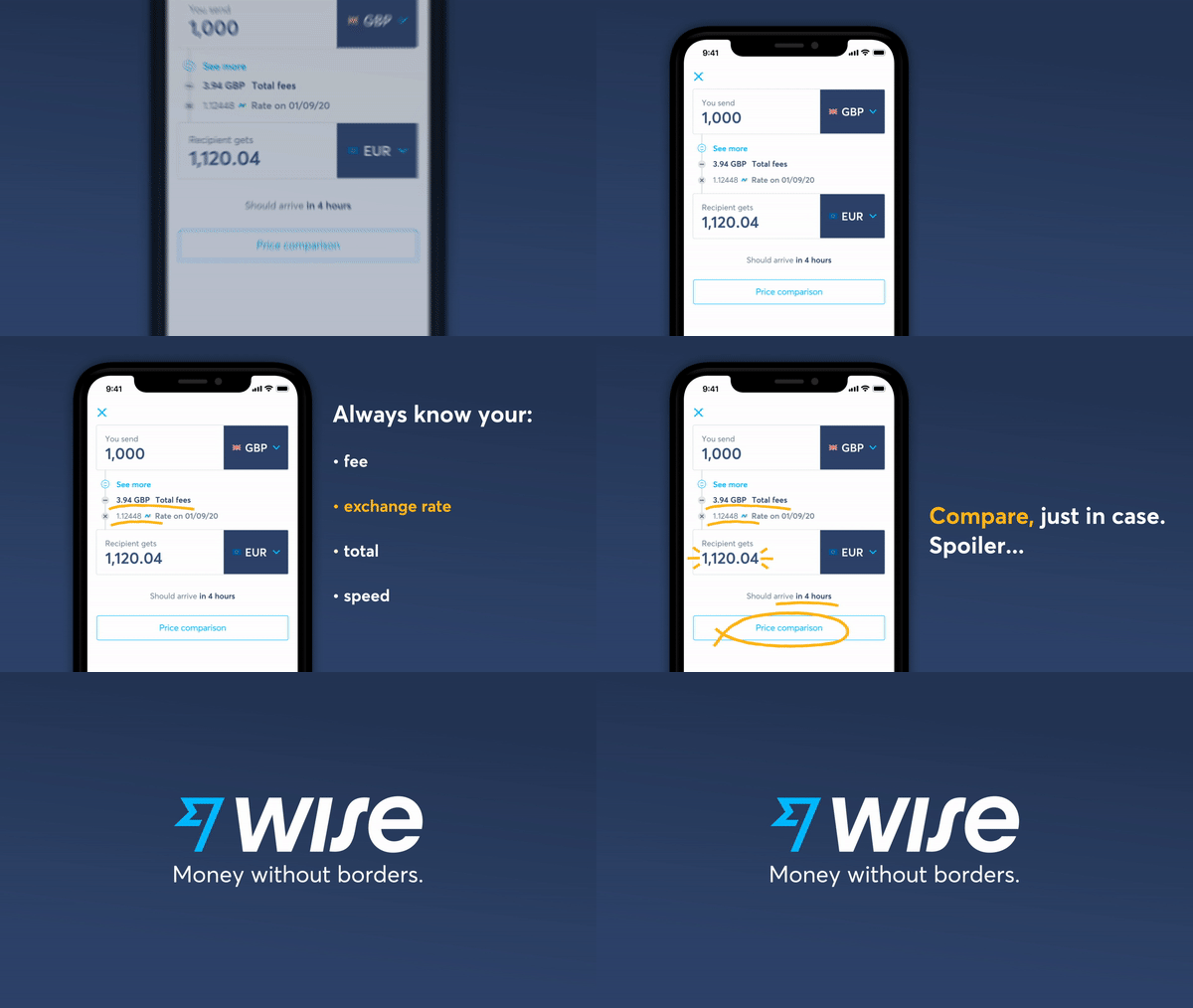
With running your own business, you have enough on your plate. Receive international payments easily with Wise Business Account. Wise offers businesses in India account details in 8 currencies. This lets international clients pay you using a local transfer. This helps your business stand out as easy to work with. You also get a mid-market exchange rate. It is the same rate you see on Google. Wise charges a transfer fee that is shown upfront, and no other hidden markups.
Wise is used by over 10 million people worldwide. It is regulated by the FCA. Wise uses the real exchange rate on every transfer. Your beneficiary can receive more than with most providers.
The bottom line
Both Payoneer and PayPal are similar. And if you use an online marketplace or service like Airbnb or Fiverr, you may not have a choice. In India, your payment options may be limited.
That said, Payoneer can sometimes cost less. It also offers receiving account details to make payments easier for customers.
But if you want to get international payments sent straight to your Indian bank account, choose Wise Business. With just one low fee and the real exchange rate, you can get more in your wallet with Wise.
💡 Best For
👉 Freelancers working on platforms
🔗 External Link
🔗 Internal Support
👉 https://moneyonliners.com/how-to-get-your-first-freelance-client/
3. Wise (Best for Global Low Fees)

✅ Overview
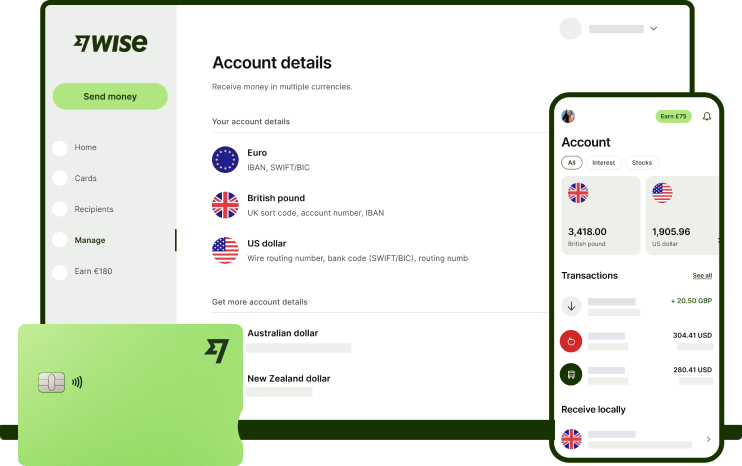
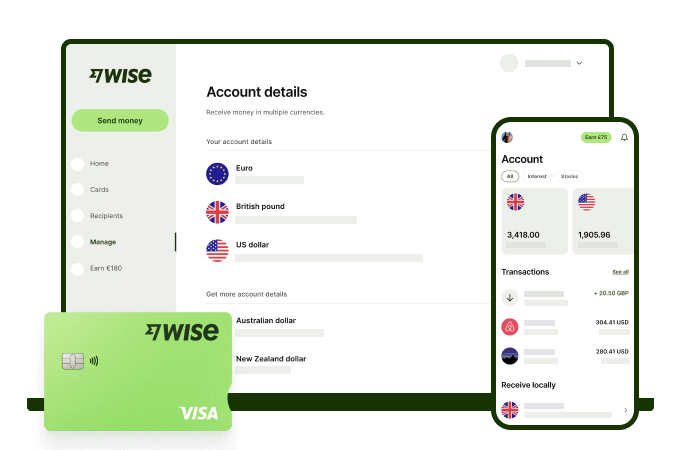
Wise (formerly TransferWise) is known for real exchange rates.
👍 Pros
- Mid-market exchange rates (no hidden markup)
- Multi-currency accounts (60+ currencies)
- Fast transfers (often minutes)
The Wise Travel card lets you hold 40+ currencies. You can spend at the interbank exchange rate. There are no forex markups or hidden fees. You can now order it for free. This is a limited-time offer, while stocks last.
Freelancing and gig economy is taking the world by storm, and even more so in India. And when you have clients from all over the world, payments should be the last thing that stops you.
Payoneer and PayPal are both online payment services that can help make international billing easier. Read on to learn more about each and see which can be the right service for your freelancing work.
And if you want a smart and cost-effective alternative to get paid in India, even if you are just starting out, consider Wise 🚀
| Payoneer | PayPal | Wise | |
|---|---|---|---|
| Fees | For 0-3.20% for payment and 1 – 4% for withdrawal | 4.40% + fixed fee depending on the currency | One transfer fee |
| Exchange Rate | Set by Payoneer, includes conversion fee of up to 3.5% | Set by PayPal, includes markup | Real mid-market exchange rate |
| Speed | 3-5 business days | Up to 5 days | Within minutes for most popular routes |
| Currencies available | 9 | 25 | 60+ |
| Convenience | Web/iOS/Android app | Web/iOS/Android app | Web/Android/ iOS app |
PayPal for freelancers: An overview
PayPal has been the original online global payment service provider and wallet. With the PayPal wallet, you can receive payments, make payments and transfer between other PayPal wallets.
PayPal also has a payment gateway for website payments and a marketplace for all sides of a market transaction. For freelancers, PayPal can be a smooth and easy way to get payments if you have a registered business.
You can not use PayPal if you don’t have a registered business. You will also get payouts into your Indian business bank account daily. But it does come with fees.
| ✅ Pros |
|---|
|
| ❌ Cons |
|---|
|
| 🔖 Read more: How to open a PayPal account in India |
|---|
PayPal fees
There are two main fees. One is 4.40% of the transaction. The other is a fixed fee that depends on the client’s, or sender’s, location. On top of that is the exchange rate fee.
But first, here are a few of the fixed fees by currency:
| Currency | Fixed Fee |
|---|---|
| US dollar | $0.30 USD |
| Euro | €0.35 Euro |
| Australian dollar | $0.30 AUD |
| British Pound | £0.20 GBP |
So for example, if you have an American client that you have charged $100 for a job:
| Amount billed | $100 |
|---|---|
| Fixed fee (4.40%) | $4.40 |
| Fixed Currency fee | $0.30 |
| US Dollar amount after fees | $95.30 |
You would then use PayPal’s exchange rate to convert $95.30 to Indian rupees. This applies when the money is deposited into your bank account.
PayPal sets its own exchange rate so that it is weaker than the real mid-market exchange rate that you see on Google. That way, PayPal sneaks in a hidden fee on every dollar or currency converted into Indian Rupees.
While it can feel like a small fee, it can add up quite quickly. Here is how it looks versus the real mid-market exchange rate for that same $95.30:
| Transaction | PayPal | Mid-market exchange rate |
|---|---|---|
| $1 USD to INR | ₹88.3 | ₹91.68 |
| For $95.30 | ₹8,414.99 | ₹8,737 |
Just that small ₹3 difference in the exchange rate ends up being a ₹323 difference in what you get in your account.
| 🔔Get free exchange rate alerts for transfers to India, or anywhere |
|---|
Time taken to receive money with PayPal
PayPal clears your account daily and automatically, so you will never have to manually withdraw the funds. But, it can take up to 5 days for the funds to appear in your Indian bank account.
Payoneer for freelancers: An overview
Payoneer is an online payment service. It lets freelancers, including those in India, get paid for work done outside India. Online marketplaces like Fiverr and Upwork use Payoneer. It is their preferred payment method for people in India.
Payoneer has the handy Receiving Accounts where clients overseas can pay locally in USD, GBP, EUR, CAD and more. It makes it easier for clients so they don’t need to convert or send money overseas. Payoneer also lets you send Payment Requests to qualifying clients.
| ✅ Pros |
|---|
|
| ❌Cons |
|---|
|
Fees
There are 3 main buckets of fees with Payoneer – for payment, for withdrawal and other miscellaneous fees. Let’s look at each.
When you are getting paid with Payoneer, the fee will depend on how and where the payment is made. Some options are free while others come with a cost:
| Transaction | Fee |
|---|---|
| From a marketplace like Fiverr, Upwork, Airbnb, and others | Fee set by marketplace |
| By USD, EUR or GBP Receiving Account | Free |
| Payments from clients from a payment request – credit card | 3.20% + $0.49 |
| Payments from clients from a payment request – ACH Bank debit (US) | 1% |
| Payments from another Payoneer customer | Free |
Now the withdrawals for Payoneer in India are done daily so you will receive a fee everyday on the amount paid to you:
| Transaction | Fee |
|---|---|
| From US Dollars, Euros, or other currencies to Indian Rupees. We charge 1% to 4% of the transaction amount. A currency conversion fee is also included in the exchange rate |
Payoneer, similar to PayPal, sets their own exchange rate which includes a currency conversion fee. While they don’t share their exchange rate, it is said their rate is 2-2.5% above the real mid-market exchange rate.
You may also run into other fees with Payoneer:
| Transaction | Fee |
|---|---|
| Paying to another Payoneer account | Free |
| Paying to a local bank account outside of Payoneer | 1% of transaction charge + any currency conversion fees if applicable |
| Moving currencies between your own Payoneer balance | 0.5% – 2% of the amount to transfer + currency conversion fee |
| If your account is open but unused for 12 months | $29.95 USD |
If you are a high earning freelancer, you may be given a break on certain fees. Also, there is a chance that your local Indian bank may also charge a fee.
Time taken to receive money with Payoneer
Payoneer pays out to Indian bank accounts automatically every 24 hours.
A simple, fast, and cheap alternative: Wise
With running your own business, you have enough on your plate. Receive international payments easily with Wise Business Account. Wise offers businesses in India account details in 8 currencies. This lets international clients pay you using a local transfer. This makes your business stand out as easy to work with. You also get a mid-market exchange rate. It is the same rate you see on Google. Wise charges a transfer fee that is shown upfront, and no other hidden markups.
Wise is used by over 10 million people worldwide. It is regulated by the FCA. Wise uses the real exchange rate for every transfer. Your beneficiary can get more than with most providers.
The bottom line
Both Payoneer and PayPal are similar. If you use an online marketplace or service like Airbnb or Fiverr, you may not be able to choose your payment option in India.
That said, Payoneer can sometimes cost less. It also offers receiving account details to make payments easier for customers.
But you can also receive international payments in your Indian bank account. Try Wise Business to get paid directly. With just one low fee and the real exchange rate, you can get more in your wallet with Wise.
**Sources used for this article:**
❌ Cons
- Not as widely recognized as PayPal
- Requires client setup sometimes
💡 Best For
👉 Freelancers who want to keep more money (low fees)
👉 Freelancers working across multiple countries
🔗 External Link
🔗 Internal Strategy
👉 https://moneyonliners.com/essential-tools-for-online-business/
4. Stripe (Best for Global Online Businesses)

✅ Overview
Stripe is ideal for freelancers running:
- Websites
- Digital products
- SaaS services
👍 Pros
- Accepts cards globally
- Subscription billing
- Highly customizable
Best payment gateway: Top 7 in 2026.
A payment gateway is a tool that streamlines the payment process for e-commerce merchants. A merchant will need a payment gateway in addition to a merchant account to process payments.
If you want to expand into the ecommerce sector, we recommend you keep reading to find the best payment gateway.

Content intended for residents of the United States. Please check your region’s Terms of Use or visit Wise’s Pricing and Fees page. It has the latest pricing and fee details.
Comparison of the best payment gateway options
Here are the best payment gateway providers for secure online credit card transactions:
Each of these online payment services has a lot to offer if you plan to sell products online. But they also have some key differences. This guide will help you decide which is the best option for your business.
Stripe
Stripe is a fintech company that offers payment management solutions. It serves both brick-and-mortar and online businesses. Stripe Payments allows you to accept credit cards, debit cards, and mobile wallets worldwide. Stripe can be a good option for developers. It offers a wide range of customization tools to tailor the payment process to your business. It also allows businesses to offer “Buy Now, Pay Later” (BNPL) payment methods, such as Klarna.
The company’s greatest strength can also be a weakness for some. Entrepreneurs with less technological expertise might not be able to take full advantage of its features.
| Cost | Useful for |
|---|---|
| Adapt the payment process to your business with customization options |
| 💡 Did you know you can link your Wise account to Stripe ? This means you can receive money in multiple currencies, with no high fees or hidden costs! Ideal if you have an international business. |
|---|
PayPal
PayPal is one of the best online payment processors. It features an intuitive and user-friendly design, even for new business owners.
One of the main reasons to consider PayPal is that it already has many users of PayPal business accounts. However, the fees can be difficult to calculate, which may be a disadvantage for some.
| Cost | Useful for |
|---|---|
| PayPal fees vary depending on many factors. You can check how much PayPal will charge you using the PayPal fee calculator. | Simple and practical setup |
Square
Square offers user-friendly software and a convenient app for receiving customer payments. It’s a popular payment gateway service for small businesses.
Square allows businesses to set up both in-person and online payments with minimal effort and upfront costs. However, Square might not be the best fit for entrepreneurs seeking more complex payment options.
| Cost | Useful for |
|---|---|
| Free in-store and online payment setup |
Payoneer
Payoneer is an online financial services platform used by many major companies such as Airbnb and Google. The platform supports international transactions in over 200 countries and 150 local currencies.
You can use Payoneer to send payment requests that customers can pay with credit card, ACH direct debit, and direct bank transfer.
One thing to consider about Payoneer is that fees can be higher than other services. This can happen if you often receive card payments from non-Payoneer customers.
| Cost | Useful for |
|---|---|
| Receiving international transactions |
Adyen
Adyen is a popular option for doing business internationally. It has no setup or monthly fees, and you can choose when and in what currency you want to settle.
Adyen charges a fixed processing fee plus a fee determined by the payment method.
| Cost | Useful for |
|---|---|
| Premium global payment processing |
| You can also consult the guide to alternatives to Adyen below. |
|---|
Verifone (Formerly 2Checkout)
Verifone is not the best-known payment processing service. It offers an online payment gateway and optional add-on services.
With Verifone, you can receive payments from over 200 countries. There are several pricing plans with different options. The 2SELL plan offers an easy and simple way to sell globally and is the most comparable to the other options in this article.
If you prefer to sell in a physical store, this will not be the right service for your business.
| Cost | Useful for |
|---|---|
| Get a free online payment gateway for businesses that only sell online |
Braintree
Braintree, owned by PayPal, offers payment processing both in physical stores and online. It’s a simple service that accepts all popular payment methods and features a sleek interface.
The simple service lacks extra features. If you need advanced options, we recommend choosing another alternative.
| Cost | Useful for |
|---|---|
| Easy navigation and for those who appreciate an elegant interface |
| 💡 Read our guide on Braintree alternatives . |
|---|
How do payment gateways work?
Payment gateways are services you’ll find on e-commerce platforms like eBay. These gateways authorize credit card payments for all types of online businesses.
A payment gateway transmits customer information to you, as the business owner. The payment then goes through your payment processing platform.
Payment information is obtained from your payment processor and sent to your business account.
If this sounds technical, you can think of payment gateways as virtual doors. These doors create shortcuts during the payment process and keep transactions secure.
Factors to consider when looking for the best payment gateway
To make the right decision, consider the following factors:
Your business needs 💼
This question is simple: Does your business rely on online payments? If the answer is yes, you might need to invest in a payment gateway. If you only sell in physical stores, you won’t need one.
Payment gateway cost 💵
Payment gateway service prices vary. It is worth reviewing the costs to find the best option for your business.
While you can choose advanced customization options, you may want basic services if your budget is tight.
If you think your business will benefit from these extra features, a premium service may be worth the cost.
Security 🔒
Security is one of the main concerns of most customers who conduct online transactions.
If customers doubt the safety of their money, they will be reluctant to place their order. Therefore, you might consider a payment gateway with stronger security measures.
Payment methods and currencies 💳
Most small business owners conduct the majority of their transactions domestically. If you expand into the international market, a payment gateway will help you receive international payments.

Save on international payments with Wise Empresses
If you run a small business, you know how important it is to save time and money. That’s why it’s wise to consider where the money will go after it passes through the payment gateway. This matters even more if you need to make an international payment.
With a Wise Business account , you can save on international payments. Receiving money from abroad is very easy and payments are secure.
Wise isn’t a bank, but a Money Transfer Service (MSB) provider and a smart alternative to banks. The Wise Business account is made for international businesses. It makes it easy to send, store, and manage funds in over 40 currencies. Get account details in major currencies for a one-time fee. Receive international payments like a local. Send money to over 160 countries.
Also connect your Wise Business account to receive payments from e-commerce platforms like Amazon or through Stripe.
10,000 businesses join Wise every month so create your account online in just a few clicks.
❌ Cons
- Requires technical setup
- Not beginner-friendly
💡 Best For
👉 Freelancers building business systems
🔗 External Link
🔗 Internal Strategy
👉 https://moneyonliners.com/how-to-build-a-simple-blog-that-makes-money/
5. Bank Transfers (Global Traditional Method)



Bank transfers are one of the oldest and most trusted ways to send and receive money worldwide. They are widely used by freelancers, businesses, remote workers, and international companies.
Even with modern platforms like PayPal, Payoneer, Wise, and Stripe, bank transfers remain essential. This is especially true for large payments, formal contracts, and global business transactions.
What Is a Bank Transfer?
A bank transfer is the movement of money from one bank account to another.
It can happen:
- Within the same bank
- Between different banks
- Across international borders
For international payments, bank transfers use systems like:
- SWIFT (global network for international transfers)
- Wire transfers (direct bank-to-bank payments)
- ACH (mainly domestic transfers in some countries)
Why Bank Transfers Are Still Important Worldwide
1. Trusted by Businesses
Bank transfers are highly trusted by companies and institutions. They are often required for contracts, invoices, and professional payments.
2. Global Reach
Almost every country has banks, making this method accessible worldwide—even where digital wallets are limited.
3. Best for Large Payments
Bank transfers are ideal for sending large amounts of money, unlike some online platforms with limits.
4. Direct to Your Account
Funds go straight into your bank account, making it easier for:
- Saving
- Tracking income
- Business accounting
How Bank Transfers Work
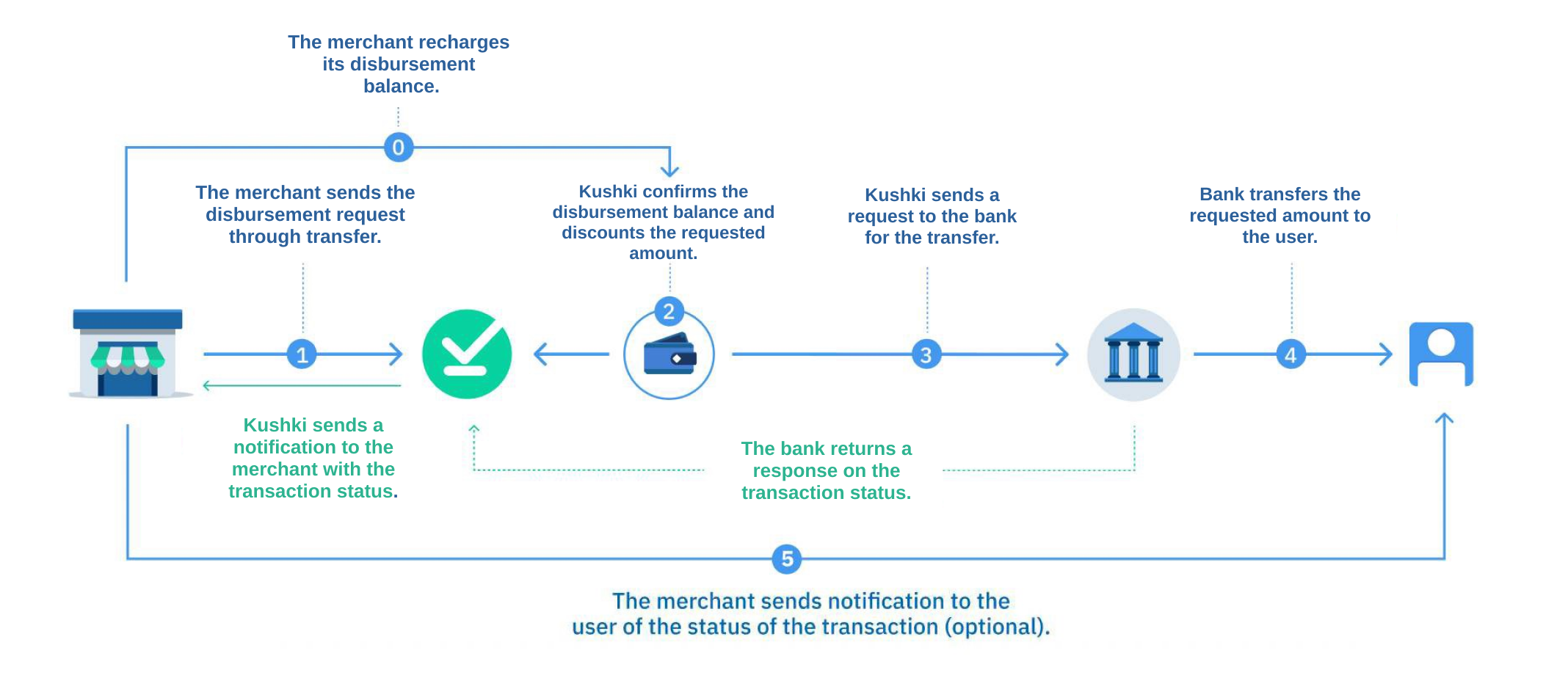
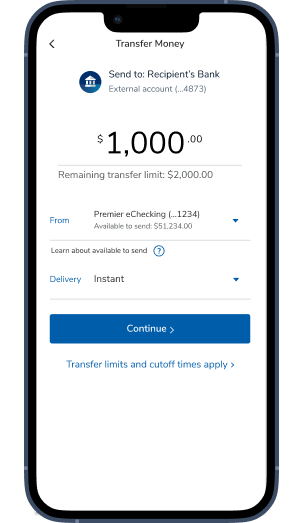

The process is simple:
- You provide your bank details
- The sender enters your information
- The bank processes the transaction
- The money arrives in your account
For international transfers, you usually need:
- Full name
- Bank name
- Account number
- SWIFT/BIC code
- IBAN (for some countries)
- Bank branch details
Advantages of Bank Transfers
Secure and Reliable
Bank transfers are regulated and trusted globally.
Professional Payment Method
Used by companies, agencies, and employers.
Works Almost Everywhere
Even in countries where PayPal or Stripe are limited.
Clear Payment Records
Every transaction is recorded, making accounting easier.
Disadvantages of Bank Transfers
Slower Processing
International transfers can take 1–5 business days.
Higher Fees
Costs may include:
- Sending fees
- Receiving fees
- Intermediary bank fees
Currency Conversion Loss
Exchange rates may not be the best.
Complex for Beginners
Understanding SWIFT, IBAN, and bank details can be confusing at first.
Real-World Example


A freelance web designer in Uganda works with a company in Germany.
- Project value: $1,500
- Payment method: Bank transfer (SWIFT)
- Time: 3–4 business days
The client chose a bank transfer because:
- It matched their accounting system
- It was secure for a large payment
👉 The freelancer received the money directly into their bank account.
Case Study 1: Freelancer Scaling Income
A freelance developer started with small payments using online wallets.
As projects grew above $1,000, clients preferred bank transfers.
Results:
- More professional image
- Easier invoicing
- Better financial tracking
👉 Lesson: Bank transfers are ideal for high-value freelance work.
Case Study 2: Digital Agency with Global Clients
A small agency serving clients in the UK and USA used bank transfers for monthly payments.
Results:
- Stable recurring income
- Strong trust with clients
- Clean accounting records
👉 Lesson: Bank transfers support long-term business relationships.
Case Study 3: Remote Employee Salary
A remote worker employed by a foreign company received monthly salary via bank transfer.
Results:
- Consistent payments
- Reliable system
- Direct deposit into bank account
👉 Lesson: Bank transfers are perfect for formal remote jobs.
When Should You Use Bank Transfers?
Use bank transfers when:
- You receive large payments ($500+)
- You work with companies or agencies
- You need formal payment proof
- Your country has limited online payment options
Important Tips Before Using Bank Transfers
- Always double-check your bank details
- Confirm SWIFT/BIC codes carefully
- Ask your bank about fees
- Track exchange rates
- Keep invoices and receipts
Pro Tips (Very Important for Your Audience)
👉 Combine bank transfers with other methods:
- Use Payoneer/Wise for faster small payments
- Use Bank transfer for large payments
👉 This creates a smart payment strategy for freelancers.
Conclusion
Bank transfers are a traditional but powerful global payment method.
They may not be the fastest or cheapest, but they remain:
- Highly trusted
- Widely accepted
- Ideal for professional and large transactions
For freelancers and online earners building serious income, bank transfers are a must-have payment option.
6. Skrill / Revolut / Others (Alternative Options)
- Skrill → good for international transfers
- Revolut → fast digital banking
- Crypto → growing in some countries
Skrill, Revolut & Other Alternative Payment Methods (Global Options for Freelancers)

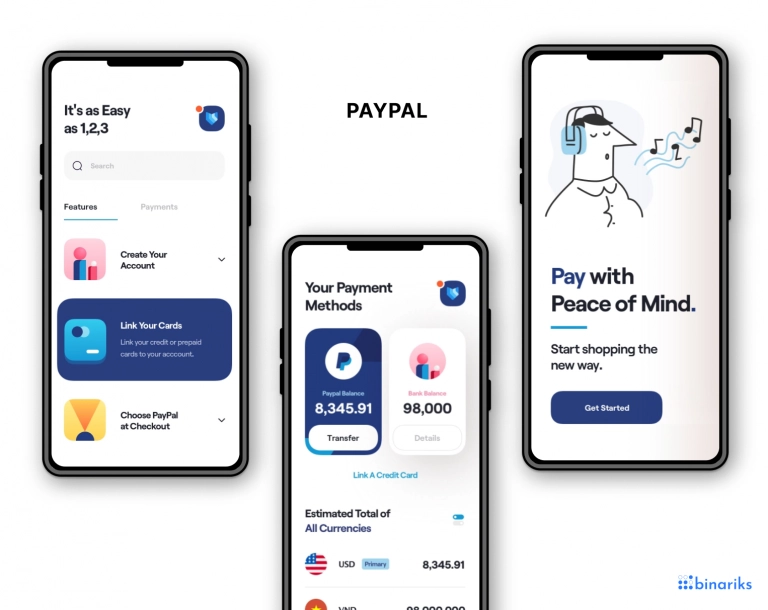
As online income grows worldwide, many freelancers and digital entrepreneurs are moving past bank transfers and PayPal.
Platforms like Skrill, Revolut, and other fintech payment apps are strong alternatives. They offer faster transactions, lower fees, and modern digital banking features.
These tools are especially useful for freelancers working with international clients, remote workers, and online businesses.
What Are Skrill, Revolut & Alternative Payment Methods?
These are digital wallets and fintech platforms that allow you to:
- Send and receive money globally
- Hold multiple currencies
- Pay online or withdraw funds
- Manage money through mobile apps
Popular Alternative Platforms
- Skrill – widely used for global transfers and online payments
- Revolut – digital banking with multi-currency accounts
- Wise (TransferWise) – low-cost international transfers
- Payeer – supports crypto + fiat payments
- Neteller – similar to Skrill, used globally
- Chipper / Flutterwave / M-Pesa (Africa) – regional payment solutions
Why These Alternatives Are Growing Fast
1. Faster Transactions
Most payments are processed instantly or within minutes.
2. Lower Fees
Compared to bank transfers, many fintech apps offer cheaper transfers.
3. Multi-Currency Support
You can hold and convert currencies like USD, EUR, GBP easily.
4. Mobile-Friendly
Everything is managed through apps—perfect for modern freelancers.
Skrill (Global Digital Wallet)

Skrill is a global payment platform used by freelancers, traders, and online businesses.
Key Features:
- Send and receive money worldwide
- Supports multiple currencies
- Offers prepaid Mastercard
- Works in many countries
Pros:
- Fast transfers
- Easy to use
- Widely accepted in online platforms
Cons:
- Fees can be high for withdrawals
- Limited support in some countries
👉 Best for: Freelancers receiving international payments and online transactions.
Revolut (Modern Digital Banking)

Revolut is a modern digital bank offering powerful global financial tools.
Key Features:
- Multi-currency accounts
- Virtual and physical cards
- Instant transfers
- Currency exchange at real rates
Pros:
- Very low exchange fees
- Clean and powerful mobile app
- Great for global travelers and remote workers
Cons:
- Not available in all countries
- Some features require paid plans
👉 Best for: Remote workers, digital nomads, and freelancers working with Europe/USA clients.
Other Alternative Payment Options

Wise (TransferWise)
- Very low fees
- Real exchange rates
- Best for international transfers
Neteller
- Similar to Skrill
- Used in freelancing and online businesses
Payeer
- Supports crypto + fiat
- Good for digital entrepreneurs
M-Pesa / Flutterwave / Chipper
- Popular in Africa
- Mobile money solutions
- Easy local transactions
Real-World Example



A freelance graphic designer in Kenya works with a UK client.
Instead of using bank transfer:
- The client pays via Wise
- The freelancer receives money instantly
- Converts GBP to local currency at a low fee
👉 Result: Faster payment + less money lost in fees.
Case Study 1: Freelancer Using Skrill
A freelancer working in online marketing used Skrill to receive payments from multiple clients worldwide.
Results:
- Faster payments than bank transfers
- Easy online transactions
- Ability to withdraw funds locally
👉 Lesson: Skrill is useful for flexible global payments.
Case Study 2: Remote Worker Using Revolut
A remote employee working with a European company used Revolut.
Results:
- Instant salary payments
- Multi-currency management
- Easy spending with a virtual card
👉 Lesson: Revolut works like a global digital bank.
Case Study 3: African Freelancer Using Mobile Money
A freelancer in Uganda used Flutterwave + Mobile Money to receive payments.
Results:
- Easy withdrawals
- Local accessibility
- Faster than traditional banks
👉 Lesson: Regional solutions can be very powerful.
When Should You Use These Alternatives?
Use Skrill, Revolut, or similar platforms when:
- You want fast payments
- You work with international clients
- You want lower fees than banks
- You need mobile-friendly tools
Smart Strategy (Very Important for Your Audience)
👉 Don’t rely on only ONE payment method.
Use a combination:
- Bank Transfer → for large payments
- PayPal/Payoneer → for clients
- Skrill/Wise/Revolut → for flexibility and speed
👉 This builds a strong global payment system.
Conclusion
Skrill, Revolut, and other fintech platforms are transforming how freelancers get paid worldwide.
They offer:
- Speed
- Flexibility
- Lower costs
- Global access
For modern online earners, these are not just alternatives—they are essential tools for scaling income globally.
📊 Global reports show:
👉 Wise & Payoneer often outperform PayPal in exchange rates
📊 Worldwide Comparison Table
| Platform | Global Reach | Fees | Speed | Best For |
|---|---|---|---|---|
| PayPal | 200+ countries | High | Instant | Beginners |
| Payoneer | Global platforms | Medium | 2–5 days | Freelancers |
| Wise | 60+ currencies | Low | Fast | Saving money |
| Stripe | Global | Medium | Fast | Businesses |
| Bank | Global | Varies | Slow | Large payments |
🌍 Real Global Case Studies
💼 Africa Freelancer (Uganda/Nigeria)
- Uses Payoneer + Wise
👉 Result: Lower fees + faster withdrawals
👉 Learn path:
🔗 https://moneyonliners.com/how-to-get-your-first-freelance-client/
🇪🇺 Europe Freelancer
- Uses Wise multi-currency
👉 Result: Saves 5% per transaction
🇺🇸 USA Freelancer
- Uses Stripe + Website
👉 Result: Automated income
👉 System here:
🔗 https://moneyonliners.com/how-to-make-money-online-2026/
⚠️ Global Mistakes to Avoid
❌ Using only PayPal
❌ Ignoring exchange rates
❌ Not diversifying payment methods
👉 Learn smarter:
🔗 https://moneyonliners.com/why-positioning-matters-more-than-talent/
🧠 Best Global Payment Strategy (2026)
👉 Combine:
- PayPal → Quick payments
- Payoneer → Platforms
- Wise → Save money
- Stripe → Scale business
👉 Full system:
🔗 https://moneyonliners.com/how-online-income-actually-works/
🎯 Final Advice
👉 The smartest freelancers don’t just earn…
They:
✔ Optimize payments
✔ Reduce fees
✔ Build systems
Start here:
🔗 https://moneyonliners.com/start-here/

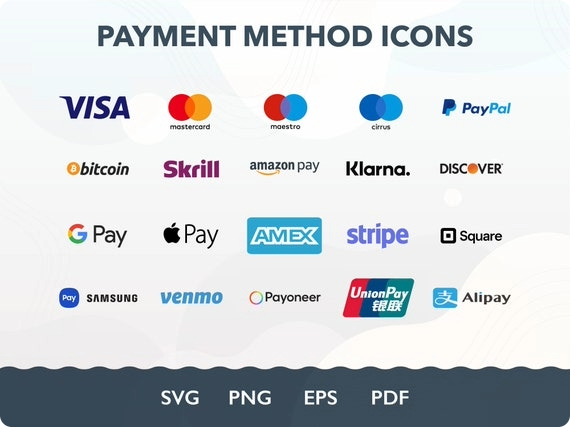
7 Comments