Beginner Guide to Freelancing and Remote Work: Complete 2026 Guide
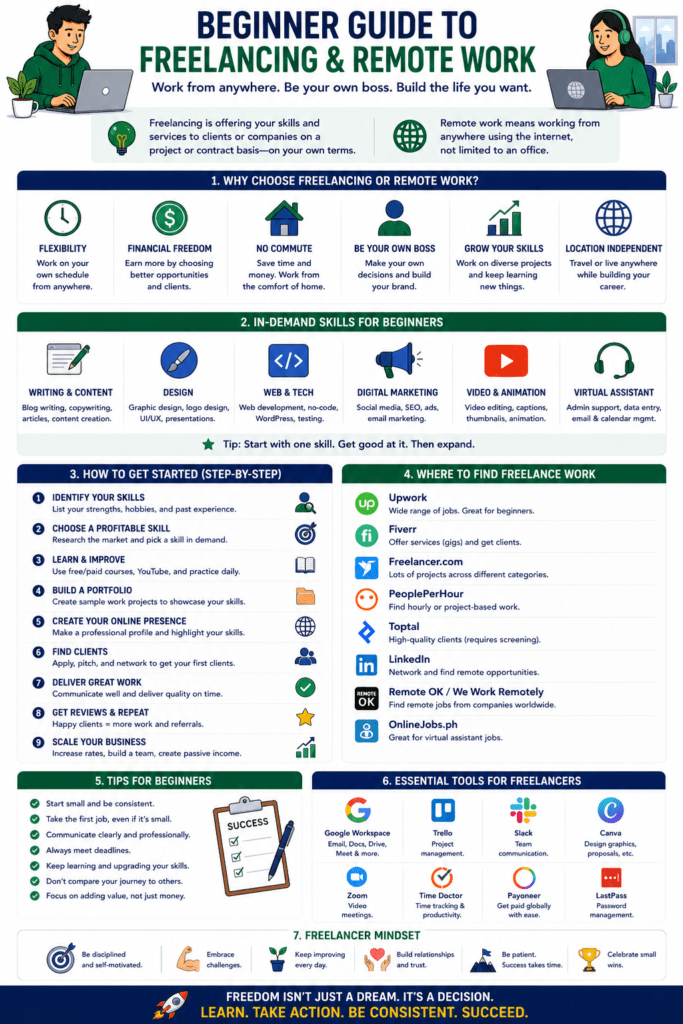
Beginner Guide to Freelancing and Remote Work
By MoneyOnliners Editorial Team
Last Updated: June 2026
Fact Checked & Reviewed
Introduction
Freelancing and remote work have created opportunities for millions of people around the world.
Today, businesses can hire talented workers regardless of location, while individuals can earn income online without working in a traditional office.
For beginners, freelancing and remote work can provide flexibility, skill development, and income opportunities that were difficult to access just a few years ago.
However, many beginners struggle because they do not understand the difference between freelancing and remote work.
Others become overwhelmed by too much information and unrealistic promises found online.
This Beginner Guide to Freelancing and Remote Work explains how both systems work, what skills are needed, where to find opportunities, how to avoid common mistakes, and how to build long-term success.
Whether your goal is earning extra income, replacing a traditional job, or building an online career, understanding freelancing and remote work is an important first step.
Before continuing, read:
👉 How Online Income Actually Works
https://moneyonliners.com/how-online-income-actually-works/
👉 How to Get Your First Freelance Client
https://moneyonliners.com/how-to-get-your-first-freelance-client/
👉 Realistic Expectations for Beginners Making Money Online
https://moneyonliners.com/realistic-expectations-for-beginners-making-money-online/
👉 Online Income vs Traditional Jobs (Real Comparison)
https://moneyonliners.com/online-income-vs-traditional-jobs/
Quick Answer
A Beginner Guide to Freelancing and Remote Work can be summarized simply:
Freelancing means offering services independently to clients, while remote work means working for a company from a location outside a traditional office.
Popular freelance and remote work opportunities include:
✅ Content Writing
✅ Virtual Assistance
✅ Customer Support
✅ Graphic Design
✅ Social Media Management
✅ SEO Services
✅ Data Entry
✅ AI-Assisted Services
Both paths can create online income opportunities, but they require different approaches and expectations.
Table of Contents
What Is Freelancing?
What Is Remote Work?
Freelancing vs Remote Work
Benefits of Freelancing
Benefits of Remote Work
Skills Beginners Should Learn
Beginner-Friendly Freelance Services
Beginner-Friendly Remote Jobs
How to Get Your First Client
How to Get Your First Remote Job
Tools You Need
Common Beginner Mistakes
Building Long-Term Success
Real-World Examples
Why Beginner Guide to Freelancing and Remote Work Matters
High-Priority Incoming Links
Topic Cluster Incoming Links
Continue Learning
FAQ
Recommended External Resources
Research Methodology
About the Author
Editorial Mission
Editorial Standards
Google Search Console Checklist
Final Thoughts
What Is Freelancing?
Freelancing means offering services directly to clients rather than working as a permanent employee.
Freelancers typically:
Set their own rates
Choose projects
Manage schedules
Work with multiple clients
Common freelance services include:
Writing
Graphic Design
Video Editing
Virtual Assistance
SEO
Web Development
Social Media Management
One reason many people like freelancing is flexibility.
However, freelancers are also responsible for finding clients and managing their businesses.
What Is Remote Work?
Remote work means working for a company while performing duties outside a traditional office.
Remote workers may work:
From home
From co-working spaces
While traveling
From another city or country
Remote jobs often provide:
Regular salaries
Structured schedules
Employee benefits
Long-term stability
Many companies now hire remote workers globally.
Freelancers often work independently while managing multiple clients and projects.
Freelancing vs Remote Work
Although both involve online work, they are different systems.
| Freelancing | Remote Work |
|---|---|
| Self-employed | Company employee |
| Multiple clients | Usually one employer |
| Flexible schedule | Often structured schedule |
| Variable income | More stable income |
| Business ownership | Employment relationship |
Key Lesson
Neither option is better for everyone.
The best choice depends on personal goals, risk tolerance, and preferred work style.
Benefits of Freelancing
Freelancing offers several advantages:
Flexible schedules
Income growth potential
Global clients
Skill development
Business ownership opportunities
Many online entrepreneurs begin as freelancers before creating larger businesses.
Benefits of Remote Work
Remote work also offers important benefits:
Stable income
Predictable schedules
Team support
Professional development
Reduced commuting costs
Many beginners prefer remote work because it provides more structure.

Remote work allows employees to contribute to organizations without working in a traditional office environment.
Real-World Example
Virtual Assistant
Many virtual assistants begin by helping businesses manage emails, schedules, customer inquiries, and administrative tasks.
Some eventually transition from freelancing into long-term remote positions.
Key Lesson
Skills often create opportunities in both freelancing and remote work.
Internal Resources
👉 How Online Income Actually Works
https://moneyonliners.com/how-online-income-actually-works/
👉 How to Get Your First Freelance Client
https://moneyonliners.com/how-to-get-your-first-freelance-client/
👉 How to Choose a Freelance Skill as a Beginner
https://moneyonliners.com/how-to-choose-a-freelance-skill/
👉 Realistic Expectations for Beginners Making Money Online
https://moneyonliners.com/realistic-expectations-for-beginners-making-money-online/
👉 Online Income vs Traditional Jobs (Real Comparison)
https://moneyonliners.com/online-income-vs-traditional-jobs/
👉 Best AI Tools for Freelancers in 2026
https://moneyonliners.com/best-ai-tools-for-freelancers-2026/
👉 AI Online Income Opportunities Guide
https://moneyonliners.com/ai-online-income-opportunities-guide/
Skills Beginners Should Learn First
One of the biggest mistakes beginners make is searching for jobs before developing valuable skills.
Businesses hire freelancers and remote workers because they solve problems.
The more valuable your skills become, the easier it often becomes to find opportunities.
Beginner-Friendly Skills Table
| Skill | Freelancing | Remote Work | Demand |
|---|---|---|---|
| Content Writing | High | Medium | High |
| Virtual Assistance | High | High | High |
| Customer Support | Low | High | High |
| Graphic Design | High | Medium | High |
| Social Media Management | High | Medium | High |
| SEO | High | Medium | High |
| Data Entry | Medium | High | Medium |
| AI-Assisted Services | High | Medium | Growing |
Key Lesson
Focus on learning one valuable skill before trying to learn everything.
Best Freelance Services for Beginners
Many successful freelancers begin with simple services.
You do not need to become an expert immediately.
Start where you are and improve over time.
Beginner Freelance Services Comparison
| Service | Difficulty | Startup Cost | Income Potential |
|---|---|---|---|
| Content Writing | Low | Low | High |
| Virtual Assistance | Low | Low | Medium |
| Social Media Management | Medium | Low | High |
| Graphic Design | Medium | Low | High |
| Video Editing | Medium | Medium | High |
| SEO Services | Medium | Low | Very High |
| AI Content Assistance | Low | Low | Growing |
Real-World Example
Many Fiverr sellers start by offering simple writing, virtual assistant, or social media services before expanding into higher-paying specialties.
Mini Case Study
A beginner starts offering virtual assistant services for $5–$10 per task.
Within months, client relationships improve and recurring work begins generating predictable monthly income.
Key Lesson
Small projects often create larger opportunities.
Best Remote Jobs for Beginners
Remote work can provide stability while allowing flexibility.
Many companies hire beginners for remote positions.
Beginner Remote Jobs Table
| Job Type | Experience Needed | Remote Friendly |
|---|---|---|
| Customer Support | Low | High |
| Virtual Assistant | Low | High |
| Data Entry | Low | High |
| Content Moderator | Low | High |
| Writer | Medium | High |
| Social Media Assistant | Low | High |
| Administrative Assistant | Low | High |
Real-World Example
Many remote customer support representatives begin without advanced qualifications and later move into supervisory or management roles.
Key Lesson
Remote jobs often provide valuable experience while building professional skills.
Freelancing vs Remote Work Income Comparison
One of the most common questions in this Beginner Guide to Freelancing and Remote Work is:
“Which option pays more?”
The answer depends on experience, skills, and consistency.
Income Comparison Table
| Stage | Freelancing | Remote Work |
|---|---|---|
| Beginner | Variable | Stable |
| Intermediate | Higher Potential | Moderate Growth |
| Advanced | Very High Potential | High Stability |
| Long-Term | Business Potential | Career Growth |
Quote Box
Freelancing offers greater income potential, while remote work often provides greater stability.
Key Lesson
Some people combine both strategies to balance risk and income.
How to Get Your First Freelance Client
Finding the first client is often the hardest step.
After the first client, confidence and experience begin increasing.
Freelance Client Roadmap
| Step | Action |
|---|---|
| Step 1 | Choose One Service |
| Step 2 | Create Sample Work |
| Step 3 | Build Portfolio |
| Step 4 | Create Fiverr or Upwork Profile |
| Step 5 | Apply for Opportunities |
| Step 6 | Deliver Quality Work |
| Step 7 | Request Reviews |
Mini Case Study
A beginner writer creates three sample articles and begins applying for projects daily.
Within weeks, the first client is secured.
Key Lesson
Consistency often matters more than perfection.
How to Get Your First Remote Job
Remote jobs often require a different strategy than freelancing.
Employers typically evaluate:
Skills
Communication
Reliability
Experience
Professionalism
Remote Job Roadmap
| Step | Action |
|---|---|
| Step 1 | Improve Skills |
| Step 2 | Create Resume |
| Step 3 | Create LinkedIn Profile |
| Step 4 | Search Remote Job Boards |
| Step 5 | Submit Applications |
| Step 6 | Attend Interviews |
| Step 7 | Secure Position |
Real-World Example
Many remote workers secure opportunities through LinkedIn, company websites, and specialized remote job boards.
Key Lesson
Professional communication significantly improves hiring opportunities.

Creating a simple portfolio is often one of the first steps toward attracting freelance clients.
Common Beginner Mistakes
Many people fail because they repeat the same mistakes.
Common Mistakes Table
| Mistake | Result |
|---|---|
| Chasing Quick Money | Frustration |
| Switching Skills Constantly | Slow Progress |
| Poor Communication | Lost Opportunities |
| Giving Up Too Early | Missed Growth |
| Ignoring Learning | Limited Income |
| Undervaluing Services | Low Earnings |
Real-World Example
A freelancer constantly changes niches every month.
Without consistency, no expertise develops and results remain weak.
Key Lesson
Focus and persistence create momentum.
Building Long-Term Success
The most successful freelancers and remote workers usually focus on:
Continuous learning
Skill improvement
Client relationships
Professional communication
Long-term thinking
Long-Term Growth Roadmap
| Stage | Focus |
|---|---|
| Month 1–3 | Learn Skills |
| Month 3–6 | Gain Experience |
| Month 6–12 | Increase Rates |
| Year 1–2 | Build Reputation |
| Year 2+ | Scale Income |
Mini Case Study
A virtual assistant starts with one client.
After developing systems and skills, multiple long-term clients are secured, creating a stable business.
Key Lesson
Growth often comes from improving systems rather than working longer hours.
Essential Tools for Freelancers and Remote Workers
Tools Comparison Table
| Tool | Purpose |
|---|---|
| ChatGPT | Research & Productivity |
| Canva | Graphic Design |
| Grammarly | Writing & Editing |
| Google Workspace | Collaboration |
| Zoom | Meetings |
| Notion | Organization |
| Trello | Project Management |
| Networking |
Quote Box
Tools help people work smarter, but skills remain the foundation of long-term success.

Successful remote workers often use digital tools to improve communication, organization, and efficiency.
Real-World Success Example
From Freelance Writer to Remote Marketing Specialist
A beginner starts freelance writing projects online.
Over time:
Writing skills improve
SEO knowledge grows
Marketing experience develops
Eventually, these skills help secure a full-time remote marketing position.
Key Lesson
Freelancing and remote work can complement each other rather than compete.
Authority References
Research from Google, LinkedIn, the World Economic Forum, Microsoft, and major remote work studies consistently shows growing demand for digital skills, remote collaboration, communication abilities, and adaptable professionals.
The future workforce increasingly values people who can work effectively online while continuously improving their skills.
Internal Resources
👉 How to Get Your First Freelance Client
https://moneyonliners.com/how-to-get-your-first-freelance-client/
👉 How to Choose a Freelance Skill as a Beginner
https://moneyonliners.com/how-to-choose-a-freelance-skill/
👉 Freelancing for Beginners
https://moneyonliners.com/freelancing-for-beginners/
👉 Best AI Tools for Freelancers in 2026
https://moneyonliners.com/best-ai-tools-for-freelancers-2026/
👉 AI Online Income Opportunities Guide
https://moneyonliners.com/ai-online-income-opportunities-guide/
👉 Online Income vs Traditional Jobs (Real Comparison)
https://moneyonliners.com/online-income-vs-traditional-jobs/
👉 Realistic Expectations for Beginners Making Money Online
https://moneyonliners.com/realistic-expectations-for-beginners-making-money-online/
Incoming Link Opportunities
This article should receive incoming links from:
How to Get Your First Freelance Client
How to Choose a Freelance Skill as a Beginner
Freelancing for Beginners
Best AI Tools for Freelancers in 2026
Online Income vs Traditional Jobs
Realistic Expectations for Beginners Making Money Online
AI Online Income Opportunities Guide
How Online Income Actually Works
These articles strengthen both the Freelancing Cluster and Online Income Cluster while supporting topical authority.
Why Beginner Guide to Freelancing and Remote Work Matters
Understanding the Beginner Guide to Freelancing and Remote Work is becoming increasingly important as more businesses embrace digital work and global hiring.
The Beginner Guide to Freelancing and Remote Work helps beginners understand how online work opportunities function in today’s rapidly changing economy.
Many people discover the Beginner Guide to Freelancing and Remote Work while searching for flexible income opportunities that allow them to work from home or from anywhere with an internet connection.
One reason the Beginner Guide to Freelancing and Remote Work matters is that traditional employment is no longer the only path to earning an income.
The Beginner Guide to Freelancing and Remote Work explains how individuals can use skills, technology, and online platforms to connect with clients and employers worldwide.
Many beginners benefit from the Beginner Guide to Freelancing and Remote Work because it helps simplify a topic that often feels overwhelming.
The Beginner Guide to Freelancing and Remote Work also teaches the differences between freelancing and remote employment, helping readers choose the path that best fits their goals.
Another reason the Beginner Guide to Freelancing and Remote Work matters is that digital skills are becoming increasingly valuable across industries.
The Beginner Guide to Freelancing and Remote Work encourages readers to focus on building skills that create long-term opportunities rather than chasing quick results.
People who understand the Beginner Guide to Freelancing and Remote Work are often better prepared to identify legitimate opportunities and avoid scams.
The Beginner Guide to Freelancing and Remote Work highlights the importance of communication, professionalism, reliability, and continuous learning.
Many successful freelancers and remote workers began with little experience, which demonstrates why the Beginner Guide to Freelancing and Remote Work focuses on gradual progress.
The Beginner Guide to Freelancing and Remote Work helps readers understand that building an online career often requires patience and consistency.
Another reason the Beginner Guide to Freelancing and Remote Work matters is that remote work and freelancing continue expanding across industries worldwide.
The Beginner Guide to Freelancing and Remote Work provides a foundation for understanding how digital work opportunities are evolving.
People who follow the principles in the Beginner Guide to Freelancing and Remote Work often develop stronger professional habits and more realistic expectations.
The Beginner Guide to Freelancing and Remote Work also demonstrates how skills developed through freelancing can lead to remote employment opportunities and vice versa.
Understanding the Beginner Guide to Freelancing and Remote Work can help readers build confidence while navigating online opportunities.
The Beginner Guide to Freelancing and Remote Work emphasizes creating value for clients and employers, which remains one of the most important drivers of long-term success.
Ultimately, the Beginner Guide to Freelancing and Remote Work provides a practical roadmap for building sustainable online income opportunities in an increasingly digital world.
High-Priority Incoming Links
How to Get Your First Freelance Client
https://moneyonliners.com/how-to-get-your-first-freelance-client/
This guide helps beginners understand one of the most important milestones in freelancing: securing the first paying client.
How to Choose a Freelance Skill as a Beginner
https://moneyonliners.com/how-to-choose-a-freelance-skill/
Choosing the right skill can significantly improve long-term freelancing and remote work success.
Freelancing for Beginners
https://moneyonliners.com/freelancing-for-beginners/
Learn the foundations of freelancing, client management, pricing, and skill development.
Online Income vs Traditional Jobs (Real Comparison)
https://moneyonliners.com/online-income-vs-traditional-jobs/
Compare the advantages and challenges of online work and traditional employment.
Realistic Expectations for Beginners Making Money Online
https://moneyonliners.com/realistic-expectations-for-beginners-making-money-online/
Understand realistic timelines and growth expectations for online income opportunities.
Topic Cluster Incoming Links
Freelancing Guides
How to Get Your First Freelance Client
https://moneyonliners.com/how-to-get-your-first-freelance-client/
How to Choose a Freelance Skill as a Beginner
https://moneyonliners.com/how-to-choose-a-freelance-skill/
Freelancing for Beginners
https://moneyonliners.com/freelancing-for-beginners/
Best Beginner Fiverr Gigs That Still Work in 2026
https://moneyonliners.com/best-beginner-fiverr-gigs-that-still-work/
Best AI Tools for Freelancers in 2026
https://moneyonliners.com/best-ai-tools-for-freelancers-2026/
Online Income Guides
How Online Income Actually Works
https://moneyonliners.com/how-online-income-actually-works/
Realistic Expectations for Beginners Making Money Online
https://moneyonliners.com/realistic-expectations-for-beginners-making-money-online/
Why Most People Fail at Making Money Online
https://moneyonliners.com/why-most-people-fail-at-making-money-online/
How Small Online Income Streams Become Successful Businesses
https://moneyonliners.com/how-small-online-income-streams-become-successful-businesses/
AI & Future Digital Skills Guides
AI Online Income Opportunities Guide
https://moneyonliners.com/ai-online-income-opportunities-guide/
How AI Is Changing Online Income Opportunities
https://moneyonliners.com/how-ai-is-changing-online-income-opportunities/
Skills That Stay Valuable With AI
https://moneyonliners.com/skills-that-stay-valuable-with-ai/
Blogging & SEO Guides
How Blogs Make Money in 2026
https://moneyonliners.com/how-blogs-make-money-in-2026/
How Long Does SEO Take for a New Website?
https://moneyonliners.com/how-long-does-seo-take-for-a-new-website/
How Google Really Finds and Indexes New Websites
https://moneyonliners.com/how-google-really-finds-and-indexes-new-websites/
Continue Learning
Freelancing Guides
How to Get Your First Freelance Client
https://moneyonliners.com/how-to-get-your-first-freelance-client/
Freelancing for Beginners
https://moneyonliners.com/freelancing-for-beginners/
How to Choose a Freelance Skill as a Beginner
https://moneyonliners.com/how-to-choose-a-freelance-skill/
Best AI Tools for Freelancers in 2026
https://moneyonliners.com/best-ai-tools-for-freelancers-2026/
Remote Work Guides
Online Income vs Traditional Jobs (Real Comparison)
https://moneyonliners.com/online-income-vs-traditional-jobs/
Realistic Expectations for Beginners Making Money Online
https://moneyonliners.com/realistic-expectations-for-beginners-making-money-online/
Online Income Guides
How Online Income Actually Works
https://moneyonliners.com/how-online-income-actually-works/
How Small Online Income Streams Become Successful Businesses
https://moneyonliners.com/how-small-online-income-streams-become-successful-businesses/
Why Most People Fail at Making Money Online
https://moneyonliners.com/why-most-people-fail-at-making-money-online/
Frequently Asked Questions
What is the difference between freelancing and remote work?
Many people reading a Beginner Guide to Freelancing and Remote Work often assume that freelancing and remote work are the same thing. While both allow you to work online and often from home, there are important differences in how income is earned, how work is managed, and how job security works.
Freelancing involves working independently for multiple clients rather than being employed by a single company. A freelancer typically offers services such as writing, graphic design, web development, virtual assistance, or digital marketing. In a Beginner Guide to Freelancing and Remote Work, freelancing is usually presented as a business where you are responsible for finding clients, setting prices, and managing projects.
Remote work, on the other hand, usually means working as an employee for a company while performing your duties from a location outside the traditional office. A remote worker often has a salary, assigned responsibilities, company benefits, and a manager who oversees their work. This makes remote work feel more like a traditional job with added flexibility.
One major difference highlighted in any Beginner Guide to Freelancing and Remote Work is income structure. Freelancers are typically paid per project, per hour, or per contract. Their income can vary from month to month depending on the number of clients and projects they secure. Remote workers usually receive a fixed salary or regular paycheck.
Another key difference is job security. Freelancers enjoy greater freedom but often face income uncertainty. If a client ends a contract, the freelancer must find new work. Remote workers generally have more predictable income because they remain employed by the same organization over time.
Flexibility is another area where freelancing and remote work differ. A Beginner Guide to Freelancing and Remote Work often explains that freelancers have the freedom to choose clients, set schedules, and decide which projects to accept. Remote workers may work from home but still follow company schedules, meetings, and performance expectations.
Freelancers are responsible for running their own business operations. This includes marketing services, negotiating contracts, handling invoices, and managing taxes. Remote workers typically do not handle these responsibilities because the company manages payroll, taxes, and administrative tasks.
Career growth can also look different. Freelancers can scale their income by raising rates, expanding services, building agencies, or creating digital products. Remote workers often advance through promotions, salary increases, leadership opportunities, and specialized career paths within their organizations.
Many beginners choose remote work first because it offers stability while they build online skills. Others prefer freelancing because of the flexibility and income potential. A Beginner Guide to Freelancing and Remote Work should help readers understand that neither option is universally better; the best choice depends on personal goals, risk tolerance, and lifestyle preferences.
Ultimately, both freelancing and remote work provide valuable opportunities to earn online. Understanding the differences between these two paths is an important step in any Beginner Guide to Freelancing and Remote Work. By learning how each model works, beginners can make informed decisions and choose the online career path that best fits their long-term goals.
Is freelancing better than remote work?
Neither is universally better. Freelancing offers greater flexibility and income potential, while remote work often provides more stability.
Can beginners start freelancing with no experience?
What skills are best for beginners?
Content writing, virtual assistance, customer support, social media management, graphic design, and AI-assisted services are popular beginner-friendly options.
One of the most common questions people ask when reading a Beginner Guide to Freelancing and Remote Work is which skills are best for beginners. Choosing the right skill can make it easier to find clients, build confidence, and start earning online. The best beginner skills are usually those that are in demand, easy to learn, and practical for real-world work.
A Beginner Guide to Freelancing and Remote Work should explain that beginners do not need to master highly technical skills immediately. Many successful freelancers start with simple services and gradually expand their expertise as they gain experience. The key is to focus on one skill and improve consistently.
Content writing is one of the best skills for beginners. Businesses, blogs, and websites constantly need articles, product descriptions, social media posts, and website content. Writing can be learned through practice, and beginners can build a portfolio by creating sample articles on topics they enjoy.
Virtual assistance is another excellent option featured in many Beginner Guide to Freelancing and Remote Work resources. Virtual assistants help businesses with tasks such as email management, scheduling appointments, data entry, customer support, and research. These tasks often require organization and communication rather than advanced technical knowledge.
Social media management is becoming increasingly popular among beginners. Many small businesses need help managing Facebook, Instagram, LinkedIn, TikTok, and other social media accounts. Learning basic content creation, scheduling posts, and audience engagement can open up valuable freelance opportunities.
Graphic design using beginner-friendly tools such as Canva is another skill worth considering. A Beginner Guide to Freelancing and Remote Work should highlight that beginners can create social media graphics, presentations, marketing materials, and simple branding assets without needing advanced design software.
Data entry remains a common starting point for new freelancers. While it may not be the highest-paying skill, it can help beginners gain experience working with clients, meeting deadlines, and understanding online work environments. It often serves as a stepping stone to more advanced services.
Customer support is another valuable skill discussed in a Beginner Guide to Freelancing and Remote Work. Many companies hire remote workers and freelancers to handle customer inquiries, live chat support, and email assistance. Strong communication and problem-solving abilities are often more important than technical expertise.
Basic digital marketing skills can also create opportunities for beginners. Learning search engine optimization (SEO), email marketing, content marketing, and online advertising can provide long-term career growth. As businesses continue to expand online, digital marketing remains one of the most in-demand skill categories.
Ultimately, a Beginner Guide to Freelancing and Remote Work should encourage beginners to choose a skill that matches their interests and strengths. Whether it is writing, virtual assistance, social media management, graphic design, data entry, customer support, or digital marketing, success comes from consistent learning and practice. The best skill is often the one you enjoy enough to keep improving over time.
How long does it take to get a freelance client?
Results vary, but consistent applications, portfolio building, and skill development often improve success rates.
Can freelancing become a full-time career?
Yes. Many freelancers eventually build full-time businesses or transition into remote leadership and consulting roles.
One of the most common questions readers ask in a Beginner Guide to Freelancing and Remote Work is whether freelancing can become a full-time career. The answer is yes. Millions of people around the world earn their entire income through freelancing. Many successful freelancers have built long-term careers by consistently developing skills, serving clients, and adapting to changing market demands.
A Beginner Guide to Freelancing and Remote Work should explain that freelancing is not just a side hustle. While many people start freelancing part-time, it can eventually grow into a full-time profession. Some freelancers earn income equal to traditional jobs, while others exceed the earnings of many salaried employees.
One reason freelancing can become a full-time career is the growing demand for digital services. Businesses increasingly hire freelancers for writing, graphic design, web development, digital marketing, video editing, virtual assistance, and many other services. This demand creates ongoing opportunities for skilled professionals.
A Beginner Guide to Freelancing and Remote Work should also highlight that successful freelancers treat their work like a business. They focus on building client relationships, delivering quality work, meeting deadlines, and maintaining professional communication. These habits help create a stable stream of projects over time.
Income growth is another reason many people choose freelancing as a long-term career. Unlike traditional employment, freelancers can often increase earnings by raising rates, expanding services, specializing in profitable niches, or working with higher-paying clients. This flexibility allows income to grow alongside experience.
However, a Beginner Guide to Freelancing and Remote Work should be realistic about the challenges. Freelancers do not usually receive employee benefits such as paid leave, health insurance, or retirement plans. They are responsible for managing finances, paying taxes, and planning for periods when work may be slower.
Building a full-time freelancing career takes time. Most successful freelancers do not achieve consistent income overnight. They spend months or even years improving skills, building portfolios, collecting testimonials, and establishing a professional reputation. Patience and persistence are essential.
A Beginner Guide to Freelancing and Remote Work should also emphasize the importance of continuous learning. Technology, client expectations, and market trends change regularly. Freelancers who continue learning new skills and adapting to industry changes are more likely to remain competitive and successful.
Many freelancers eventually expand beyond individual client work. Some create agencies, hire team members, develop digital products, launch online courses, or build content websites. These additional income streams can provide greater stability and growth opportunities over the long term.
Ultimately, a Beginner Guide to Freelancing and Remote Work should reassure beginners that freelancing can absolutely become a full-time career. While success requires effort, skill development, and consistency, freelancing offers flexibility, income potential, and independence that make it an attractive career path for people seeking online work opportunities.
Recommended External Resources
Freelancing Resources
Fiverr
Upwork
Freelancer.com
PeoplePerHour
https://www.peopleperhour.com/
Remote Work Resources
FlexJobs
We Work Remotely
Remote OK
Remote.co
Working Nomads
https://www.workingnomads.com/
Learning Resources
Coursera
LinkedIn Learning
https://www.linkedin.com/learning/
edX
Google Digital Garage
https://learndigital.withgoogle.com/
Microsoft Learn
Business Resources
Harvard Business Review
Entrepreneur Magazine
Forbes Entrepreneurs
https://www.forbes.com/entrepreneurs/
HubSpot
MIT Sloan Management Review
SEO & Marketing Resources
Google Search Central
https://developers.google.com/search
Ahrefs Blog
Moz Blog
Semrush Blog
Search Engine Journal
https://www.searchenginejournal.com/
Why These Resources Matter
The resources above provide trusted information on freelancing, remote work, digital skills, productivity, business growth, SEO, and professional development.
Following reliable sources helps beginners stay informed, improve skills, discover opportunities, and build sustainable online careers.
Research Methodology
This Beginner Guide to Freelancing and Remote Work was developed using:
Freelancing platform analysis
Remote work industry research
Workforce trend reports
World Economic Forum studies
LinkedIn workforce insights
Google documentation
Business case studies
Online income research
Real-world freelancer experiences
Professional development resources
The goal is to provide realistic, beginner-friendly, and actionable information.
About the Author
Ramathan Busulwa is the founder and editor of MoneyOnliners.com, a website dedicated to helping beginners learn practical ways to earn income online through freelancing, remote work, blogging, digital skills, SEO, and online business opportunities.
After spending years researching online income methods and digital work opportunities, Ramathan created MoneyOnliners.com to provide realistic, beginner-friendly guidance for people who want to build sustainable income streams online.
Connect With Ramathan
🌐 Website: https://moneyonliners.com
📧 Contact: info@moneyonliners.com
Editorial Mission
To help beginners build realistic online income opportunities through education, skill development, SEO knowledge, and practical step-by-step guidance.
Editorial Standards
MoneyOnliners.com strives to publish accurate, beginner-friendly, practical content based on research, real-world examples, industry best practices, and continuous learning.
Google Search Console Checklist
✔ Add featured image
✔ Optimize all 4 image alt texts
✔ Add internal links
✔ Add external authority links
✔ Add incoming links
✔ Add FAQ schema
✔ Publish article
✔ Request indexing
✔ Monitor performance
Final Thoughts
Freelancing and remote work continue creating opportunities for people who are willing to learn, adapt, and develop valuable skills.
You do not need to know everything before starting.
Focus on learning one skill.
Take consistent action.
Improve communication.
Build experience.
And continue developing your professional value over time.
Small steps today can create significant opportunities tomorrow, whether you choose freelancing, remote work, or a combination of both.