Beginner Budgeting Guide: Simple Step-by-Step Plan to Manage Your Money
Beginner Budgeting Guide: Simple Step-by-Step Plan to Manage Your Money
Learn how to understand your income, control spending, prepare for irregular costs, build savings, manage variable income, and turn a simple budget into stronger long-term financial progress.
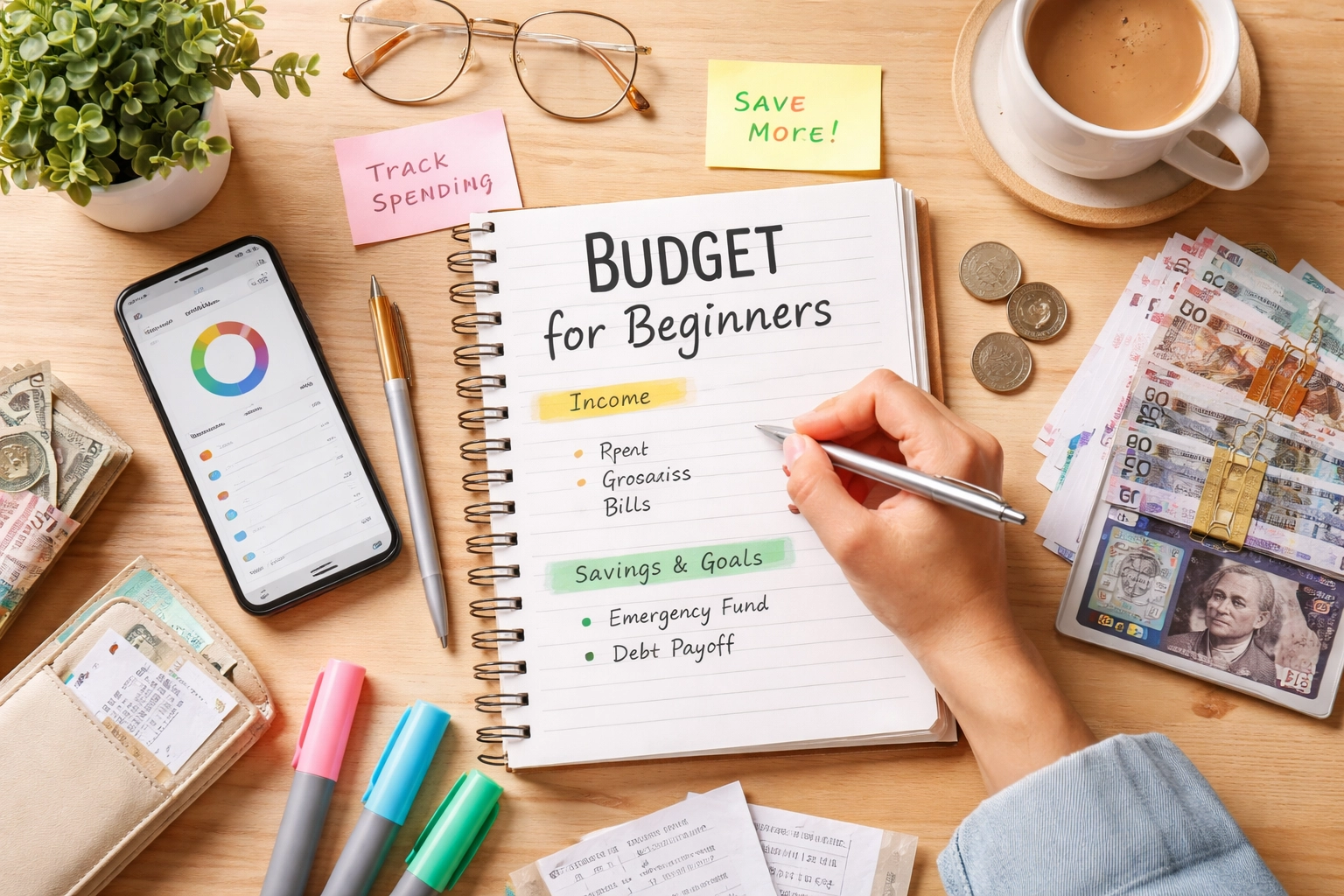
A beginner budgeting guide starts with a simple system: calculate what you actually receive, list essential and flexible expenses, plan for irregular costs, set realistic savings goals, track actual spending, and review the plan every month. The purpose is not to punish spending. It is to decide what your money should accomplish before it disappears into unplanned transactions.
Part 1 — Build Your Budgeting Foundation
This beginner budgeting guide starts with the financial basics: income, expenses, cash flow, savings, irregular costs, and realistic planning. You do not need an advanced app or complicated spreadsheet before you understand those fundamentals.
1. What Is a Budget?
A budget is a plan for how you intend to use your money during a specific period. For many beginners, monthly budgeting is easiest because housing, utilities, salaries, subscriptions and debt payments commonly operate on monthly cycles.
Budgeting changes the question from “Where did my money go?” to “Where should my money go?”
A person receives $1,000 per month and finishes the month with $30, but cannot explain where the other $970 went. A budget creates the missing visibility.

2. Why a Beginner Budgeting Guide Matters
A strong beginner budgeting guide helps you understand spending, prepare for emergencies, reduce financial pressure, build savings, plan major expenses and connect increased income with financial progress.
Know Your Income
Calculate what actually reaches you.
Know Your Expenses
List where the money goes.
Protect Essentials
Prioritize important obligations.
Plan Flexible Spending
Use realistic limits.
Plan for the Future
Include savings and predictable future costs.
Review Monthly
Improve the next budget using real data.
3. Income vs Expenses
| Category | Example |
|---|---|
| Income | Salary, wages, freelance payments, business income, commissions |
| Expenses | Housing, food, transport, utilities, debt, healthcare, personal spending |
| Savings | Emergency fund, sinking funds, long-term goals |
Three people each receive $2,000 monthly, but one spends $1,700, another $2,000, and another $2,250. Identical income does not create identical financial stability.
The Salary Increase That Changed Nothing
Samuel's income rises from $1,200 to $1,500, but his spending rises at the same time. His savings remain almost unchanged. The lesson: higher income creates opportunity, but a budget helps turn that opportunity into progress.
4. Know Your Real Monthly Income
For everyday budgeting, use money actually available to you rather than assuming your gross salary is fully spendable.
| Type | Meaning |
|---|---|
| Gross income | Income before deductions |
| Net income | Income remaining after applicable deductions |
| Budgetable income | Money actually available for planned expenses and goals |
5. Revenue Is Not the Same as Spendable Income
This matters especially for freelancers and small-business owners. Client revenue may still need to cover fees, software, contractors, taxes where applicable and other business costs.
| Item | Amount |
|---|---|
| Client revenue | $2,000 |
| Platform/payment fees | -$140 |
| Software | -$80 |
| Business internet allocation | -$60 |
| Other business costs | -$220 |
| Remaining before applicable taxes/obligations | $1,500 |
Two freelancers each report $3,000 in monthly revenue. One has $300 of business expenses while the other has $1,400. Their reported revenue is the same; the amount available after costs is not.

6. Fixed, Variable and Irregular Expenses
| Expense Type | Examples |
|---|---|
| Fixed | Rent, loan payment, insurance, fixed subscriptions |
| Variable | Food, transport, electricity, personal spending |
| Irregular | Annual insurance, school supplies, repairs, renewals |
The Car Repair Problem
John budgets for fuel and insurance but nothing for maintenance. A $500 repair later feels like a total surprise. The exact repair was unexpected, but vehicle maintenance as a category was predictable.
7. Needs vs Wants
| Expense | Possible Classification | Important Question |
|---|---|---|
| Basic groceries | Need | Is spending reasonable? |
| Restaurant meal | Usually want | How often? |
| Internet | Depends | Is it needed for work/study? |
| Smartphone | Often useful | Do you need the premium model? |
| Work software | Potential need | Does it support income? |
A freelancer pays $25 per month for software that supports client work and $80 on subscriptions they barely use. Good budgeting does not treat every subscription equally. It asks what value each expense provides.
8. Calculate Monthly Cash Flow
Total Monthly Income − Total Monthly Expenses = Monthly Cash Flow

9. Create Your First Beginner Budget
| Category | Planned Amount |
|---|---|
| Housing | $750 |
| Food | $350 |
| Transportation | $200 |
| Utilities | $180 |
| Phone & Internet | $100 |
| Insurance/Healthcare | $120 |
| Debt payment | $200 |
| Emergency savings | $200 |
| Sinking funds | $150 |
| Personal/Entertainment | $150 |
| Other | $50 |
| Total Planned | $2,450 |
| Remaining Buffer | $50 |
The Unrealistic Budget
Rebecca tries to reduce flexible personal spending from $250 to $0 overnight and abandons the budget two weeks later. A realistic reduction might have been more sustainable.
10. Choose a Beginner Budgeting Method
| Method | Best For | Main Strength | Potential Challenge |
|---|---|---|---|
| Category Budget | Beginners | Simple | Requires tracking |
| 50/30/20 | High-level planning | Easy framework | Percentages may not fit |
| Zero-Based | Detailed planners | Every dollar has a purpose | More hands-on |
| Pay Yourself First | Savings-focused users | Prioritizes goals | Must remain realistic |

11. Budgeting With Irregular Income
The $3,500 Month
Alex usually earns $1,800–$2,200 from freelance work, then has one $3,500 month and immediately raises recurring expenses. The following month income drops to $1,700. The lesson: do not build permanent expenses around temporary income.
12. Common Beginner Budgeting Mistakes
If someone earns $1,500 and only $75 of spending is genuinely unnecessary, trying to cut another $400 may be unrealistic. The next question becomes whether income also needs to increase.

13. Your First 7-Day Beginner Budgeting Challenge
Day 1
Calculate income.
Day 2
List fixed expenses.
Day 3
Review variable spending.
Day 4
Find irregular expenses.
Day 5
Calculate cash flow.
Days 6–7
Choose one improvement and build next month's budget.
One Week of Tracking
Patricia believes she spends about $200 monthly eating outside the home. One week of tracking suggests a pace closer to $365 per month. She now has enough information to make an intentional choice.

Part 2 — Build a Budget That Works in Real Life
14. Track Your Expenses
| Category | Planned | Actual |
|---|---|---|
| Housing | $700 | $700 |
| Food | $300 | $385 |
| Transportation | $180 | $210 |
| Entertainment | $100 | $175 |
| Savings | $200 | $100 |
Daniel's records show $240 more spending than expected. Small transactions across takeaway food, subscriptions, transport extras and online purchases explain the difference.

15. Control Flexible Spending
A sustainable beginner budgeting guide prioritizes rather than punishes spending. A flexible category can often be reduced without eliminating it completely.
Reducing entertainment spending from $250 to $150 preserves some enjoyment while freeing $100 for savings or another priority.
16. Plan for Bills Before They Arrive
| Bill | Due Date | Amount | Status |
|---|---|---|---|
| Rent | 1st | $700 | Planned |
| Internet | 5th | $60 | Planned |
| Electricity | 10th | $85 | Estimated |
| Phone | 15th | $40 | Planned |
Automation can help avoid missed bills, but still requires verification, enough available money, statement review and awareness of cancellation terms.
17. Build an Emergency Fund
$100 → $250 → $500 → $1,000 → One Month of Essential Expenses → Larger Reserve
The $450 Repair
Andrew's $700 emergency fund allows him to cover an essential $450 repair without immediately turning to expensive debt.

18. Save on a Low Income
A good beginner budgeting guide does not assume everyone can save the same percentage. If essential expenses consume most income, even a small sustainable contribution may be meaningful.
19. Manage Debt Within Your Budget
List each debt's balance, required payment, interest rate, due date and fees. High-cost debt and emergency savings both affect the broader financial strategy.
20. Beginner Budgeting Guide for Freelancers
Client Revenue → Business Expenses → Applicable Obligations → Available Personal Income → Personal Budget → Savings & Goals
A freelancer generating $4,000 in client revenue with $900 in business costs has $3,100 remaining before applicable taxes and other obligations. The full $4,000 is not automatically personal spending money.
The Freelancer Who Thought Revenue Was Salary
Kevin spends as if all $5,000 of a strong month were personal income, then struggles when software, fees, taxes and a weaker month arrive.

21. Beginner Budgeting Guide for Remote Workers
A remote worker saves $230 in commuting and outside-lunch costs but adds $75 in internet, electricity and work supplies. The net change is still positive in this hypothetical case, but not equal to the gross savings.
22. Budgeting for Families
A household budget only works when the information is accurate. Respectful money conversations are more useful than using the budget to police or shame another person.
23. Use Sinking Funds
Expected Cost ÷ Months Until Needed = Monthly Contribution
| Expense | Target | Months | Monthly Contribution |
|---|---|---|---|
| Annual insurance | $600 | 12 | $50 |
| Laptop replacement | $1,200 | 18 | About $66.67 |
24. Automate Your Money Carefully
Potential automations include savings transfers, bill payments and sinking-fund transfers. Automation reduces forgotten decisions, but it does not replace monitoring.
25. Choose Budgeting Tools
| Method | Advantage | Limitation |
|---|---|---|
| Notebook | Simple | Manual |
| Spreadsheet | Flexible | Requires setup |
| Bank app | Uses transaction data | May lack planning tools |
| Budgeting app | Convenient | May charge fees |

26. Review Your Budget Every Month
The Budget That Improved Every Month
Emma adjusts food, subscriptions, sinking funds and emergency savings over several months. Her first budget was not perfect; the review process made it better.
27. Three Realistic Beginner Budget Examples
| Scenario | Monthly Available Income | Key Feature |
|---|---|---|
| Lower-income beginner | $1,200 | Small but realistic savings target |
| Moderate-income beginner | $3,000 | More room for savings and sinking funds |
| Variable-income freelancer | $2,200 planning figure | Uses conservative baseline rather than best month |
Two People Earning $3,000
Two people with the same income can have different savings because their responsibilities and unavoidable expenses differ. Good budgeting compares your money with your own obligations and goals, not someone else's life.
28. The 30-Day Beginner Budgeting Guide Action Plan
Week 1 — Understand
Income, expenses, debt, cash flow.
Week 2 — Build
Create categories, limits and savings goals.
Week 3 — Track
Record real spending and compare.
Week 4 — Improve
Adjust the system and prepare next month.

Part 3 — Turn Budgeting Into Long-Term Financial Progress
Parts 1 and 2 of this beginner budgeting guide focused on understanding and controlling cash flow. Part 3 connects those habits to financial stability, goal setting, savings growth and long-term resilience.
Build More Income. Build More Freedom. Build a Better Financial Future.
29. Why a Beginner Budgeting Guide Matters Long Term
A beginner budgeting guide matters because knowing your income is not enough—you also need to understand where that income goes.
A beginner budgeting guide matters because a budget creates financial visibility.
A beginner budgeting guide matters because it separates temporary pressure from structural problems.
A beginner budgeting guide matters because it makes saving intentional.
A beginner budgeting guide matters because financial goals need numbers and timelines.
A beginner budgeting guide matters because emergency savings can reduce financial damage from unexpected expenses.
A beginner budgeting guide matters because irregular income requires more conservative planning.
A beginner budgeting guide matters because revenue is not the same as profit.
A beginner budgeting guide matters because higher income does not automatically create financial progress.
A beginner budgeting guide matters because small recurring expenses can become meaningful when combined.
A beginner budgeting guide matters because predictable annual costs should not repeatedly become emergencies.
A beginner budgeting guide matters because debt belongs inside the financial plan.
A beginner budgeting guide matters because some problems require higher income, not only lower spending.
A beginner budgeting guide matters because households need shared financial understanding.
A beginner budgeting guide matters because automation can reduce forgotten decisions.
A beginner budgeting guide matters because saving and investing serve different purposes.
A beginner budgeting guide matters because financial plans must adapt when life changes.
A beginner budgeting guide matters because progress becomes easier to measure when you track it.
A beginner budgeting guide matters because better money management can support wealth building later.
A beginner budgeting guide matters because the ultimate objective is greater control over your financial future.
30. Move From Budgeting to Financial Stability
Lydia reduces unnecessary subscriptions, avoidable fees and a few flexible expenses, creating a $200 monthly buffer without changing income.
31. Build Your Savings Rate Gradually
Amount Saved ÷ Available Income × 100 = Savings Rate
32. Avoid Lifestyle Inflation
The Promotion
Aisha's income rises by $600, but her recurring expenses also rise by about $600. Her financial margin increases by $0.

33. Budget for Specific Financial Goals
| Goal | Target | Time | Approx. Monthly Contribution |
|---|---|---|---|
| Emergency fund | $2,400 | 24 months | $100 |
| Laptop | $1,200 | 12 months | $100 |
| Training | $600 | 10 months | $60 |
34. Strengthen Your Emergency Fund Over Time
$100 Starter Buffer → $500 → $1,000 → 1 Month Essentials → Larger Reserve Appropriate to Your Situation

35. Prepare for Large Future Expenses
School Costs
A family that repeatedly borrows for $1,200 in annual school costs can begin preparing at about $100 per month if cash flow allows.
36. Budgeting Before Investing
If money is needed for next month's rent or an emergency reserve, putting it into a volatile asset because of a promise of high returns can create unnecessary risk. First ask: what is this money for, and when will I need it?
37. Budgeting With Multiple Income Streams
A side business with $800 revenue and $350 expenses contributes $450 before applicable taxes and other obligations—not the full $800—to the household financial picture.
38. Create an Income-Growth Rule
Decide in advance what increased income should accomplish before you receive it. The percentages can vary, but the principle is powerful: capture part of income growth for savings, debt reduction, learning or long-term goals.
39. Track Financial Progress Beyond Monthly Spending
| Metric | What It Shows |
|---|---|
| Monthly cash flow | Surplus or deficit |
| Emergency fund | Short-term resilience |
| Total debt | Debt direction |
| Savings rate | Saving behavior |
| Net worth | Assets minus liabilities |
| Income growth | Earning progress |
40. Protect Your Financial Progress

41. What to Do When Your Budget Stops Working
| Problem | What to Investigate |
|---|---|
| Food always exceeds budget | Target may be unrealistic |
| Savings repeatedly skipped | Contribution may be too high or poorly timed |
| Constant emergency spending | Irregular costs may be missing |
| Negative cash flow | Expenses may exceed sustainable income |
| Freelance income swings | Budget may rely on optimistic months |
| Higher income but no progress | Lifestyle inflation |
The Budget Failure That Was Actually an Income Problem
Mary earns $1,400 while essential living costs are $1,350. A generic 20% savings rule would require $280, which does not fit her current reality. The strategy needs to consider both expense optimization and income improvement.
42. Your 90-Day Beginner Budgeting Roadmap
Month 1 — Understand
Track income, expenses, debt and cash flow.
Month 2 — Stabilize
Build a starter buffer, sinking funds and better bill timing.
Month 3 — Grow
Review income growth, larger goals and long-term financial learning.

43. High-Priority Internal Links
Frequently Asked Questions
What is a beginner budgeting guide?
A beginner budgeting guide teaches someone how to understand income, expenses, savings and financial goals before moving into more complicated money-management decisions. The objective is better financial decision-making, not perfection.
How do I start a budget if I have never budgeted before?
Start with actual income, bills, bank statements, debt payments and spending. Then calculate income minus expenses and decide what the remaining money should accomplish.
How much money should a beginner save each month?
There is no universal amount. A useful savings target depends on income, essential expenses, debt, family responsibilities and goals. Small contributions can still be meaningful.
Is the 50/30/20 budget good for beginners?
It can be a useful framework, but the percentages should not be treated as mandatory because housing, healthcare, transport and food costs vary widely.
What is zero-based budgeting?
Zero-based budgeting assigns every available dollar a purpose, including savings, sinking funds, debt reduction and other goals. It does not mean spending everything.
How do I budget if my income changes every month?
Use conservative planning, avoid building permanent expenses around your highest month, and use stronger months to build reserves, prepare for taxes where applicable and fund longer-term goals.
What is the difference between an emergency fund and a sinking fund?
An emergency fund prepares for unexpected financial problems. A sinking fund prepares gradually for a known future expense such as annual insurance or school costs.
Should I save while paying debt?
The answer depends on the type and cost of the debt, your emergency reserves and other circumstances. High-interest debt can be expensive, while having no emergency savings can leave you vulnerable.
Should I invest before building an emergency fund?
Money needed for near-term expenses and emergencies serves a different purpose from money intended for long-term investing. Understand your goals, timeframe, risk tolerance and obligations first.
How often should I review my budget?
A monthly full review is a useful starting schedule, with shorter weekly checks during the month. Review sooner if income, debt or major expenses change.
Can budgeting help me become wealthy?
Budgeting alone does not guarantee wealth. It helps create control over cash flow so saving, investing and asset building become more possible over time.
What if I don't earn enough to follow my budget?
Verify that the budget is realistic. Reduce genuinely unnecessary costs where possible, but recognize that spending cuts have limits. If essential costs remain close to or above income, income growth or additional support may also be necessary.
44. Recommended External Resources
45. Research Methodology
MoneyOnliners developed this beginner budgeting guide around a practical sequence: Income → Expenses → Cash Flow → Savings → Emergency Planning → Goals → Financial Growth.
The article uses hypothetical budgets and mini case studies to explain concepts. Dollar figures are educational examples rather than claims about typical household spending. Actual budgets vary by country, income, housing costs, family size, healthcare, transportation, debt, employment and goals.
Final Thoughts
A beginner budgeting guide should not make money management feel more complicated than it needs to be.
Know what comes in. Know what goes out. Plan for what matters. Prepare for what is coming. Save what you realistically can. Review the system. Improve it as your life changes.
Your first budget will probably not be perfect. That is normal. The next one becomes better because you have more information.
The progression is simple:
Awareness → Control → Stability → Growth → Freedom
Your Next Step
Continue through the MoneyOnliners system according to the financial problem you need to solve next.
46. Google Search Console Publishing Checklist
Post-Publish GSC Workflow
Publish → Purge Cache → Confirm Live URL → Check Canonical → Confirm No Noindex → Verify Sitemap → Add Incoming Internal Links → URL Inspection → Request Indexing → Monitor Impressions, Queries and CTR.